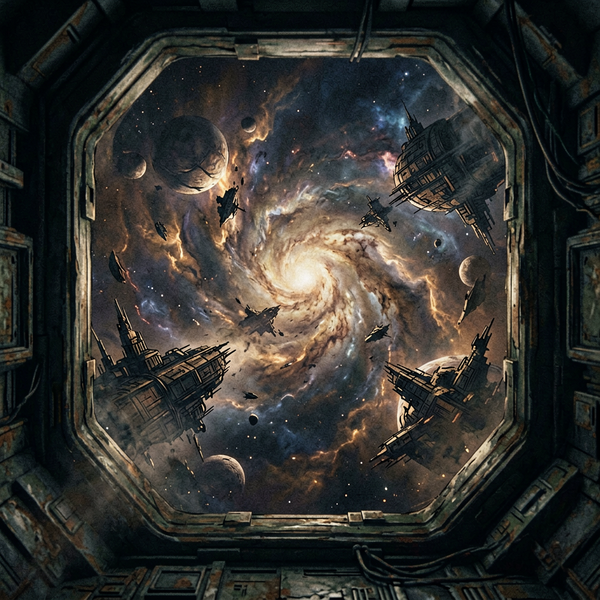
What Happens to a Body During a Jump: The Biology of Time Travel in The Stolen Stream
The 10:1 Temporal Toll is not just math — it is ossification cascades, capillary crystallization, and dream loss. What happens to a jumper body in The Stolen Stream universe.

The Body That Remembers
Time travel in The Stolen Stream isn't a flash of light and a clean landing. It's industrial-scale biological trauma—extraction, not transportation—and the body pays a price measured in decades it never lived.
The Signal Tax Is Not a Metaphor
The core mechanic is the Temporal Toll: for every year extracted from the Stream, the jumper ages ten. A one-year jump forward costs a decade of biological life. A hundred-year extraction consumes a millennium. But the numbers only tell half the story.
The Toll isn't distributed evenly. Veteran jump technicians develop a distinctive set of physiological markers the Consortium calls "chronological stress syndrome."
First comes the ossification cascade. Calcium deposits form along the spine within three jumps, visible on X-rays as faint white striations. After twenty jumps, the vertebrae begin to fuse. Technicians walk with stiff, deliberate gaits—their bones carry the literal density of borrowed decades.
Then there's capillary crystallization. The smallest blood vessels—threading through fingertips, retinas, and inner ear tissue—calcify. Jumpers lose fine sensation first: fingertips go numb, colors desaturate as retinal capillaries harden, hearing develops a permanent high-frequency ring. Technicians call it "the Stream's frequency," a tinnitus-like whine that never stops.
What the Toll Tables Don't Show
The published by the Consortium are clean spreadsheets—jump distances matched to biological costs. They omit the categories that don't fit.
Dream loss. After approximately twelve cumulative jumps, technicians stop dreaming entirely. REM cycles continue, but narrative content vanishes. Consortium researchers theorize temporal displacement fragments short-term memory consolidation, or the brain's pattern-matching systems can no longer anchor to a stable timeline. Veterans describe sleep as "falling into a hole and climbing out hours later with nothing in between."
Memorial drift. Jumpers confuse their own memories with those of the versions of themselves they extracted time from. A technician who jumps thirty years forward may recall a childhood that isn't theirs—fragments bleeding through the temporal wound. The Consortium classifies this as "borrowed recollection" and considers it an acceptable operational risk.
The gray pallor. This one everyone notices. Jumpers develop a desaturated skin tone, as if color has been pulled out of them. Medical scans show reduced melanocyte activity via an unknown mechanism. A leaked Consortium internal memo from one physician described it as "the body forgetting which version of itself it belongs to."
Why Anyone Jumps
Given this, the question becomes: why? Because for those born inside the Consortium's grip—in the where every clock is a lie—the alternative is a life without options. Jumping strips years, but refusal strips hope. The body pays for time it never lived because a body that has never time-traveled may not have a body worth living in at all.
More from the The Stolen Stream universe: The Stolen Stream Universe | The Stolen Stream Book 1 | The Stolen Stream Book 2
Related: The Ledger 004 Extinction Is A Choice · The Ledger 005 47 Deaths One Life Left · Kai Eschendorf Heir Who Refuses Time