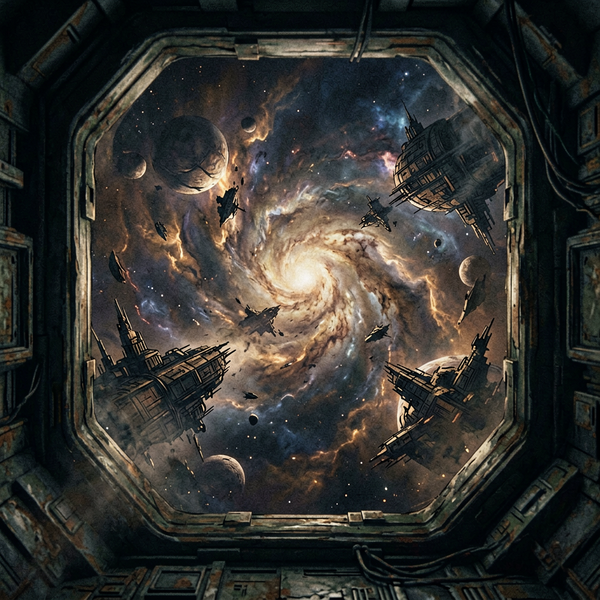
Temporal Capitalism Fiction: When Time Replaces Money

The Arithmetic of Stolen Years
When wealth is denominated in heartbeats rather than dollars, the rich do not merely own more things — they own more existence. Temporal capitalism fiction refuses the polite abstraction of money, replacing it with a single brutal ledger: your lifespan is your bank account, and every transaction leaves a scar.
Temporal Mechanics Fiction: A Genre Defined
Temporal capitalism fiction is not science fiction with clocks on the cover. It is a subgenre that treats time itself as the primary economic resource — mined, traded, hoarded, and extracted from the powerless. Unlike traditional dystopian economics, it asks the question no other genre can: what happens when your lifespan is your bank account?
Most time-travel fiction treats temporal mechanics as a puzzle box — grandfather paradoxes, closed loops, branching timelines. Temporal capitalism fiction does something different. It treats time as infrastructure. In The Stolen Stream, harvested years flow through a cosmic pipeline called the Stream, and every second in circulation was taken from someone. The extraction machinery is not hidden in a government lab — it is industrial. Factory floors. Cryogenic feed lines. Workers clocking in to have decades stripped from their biology.
The genre does not ask "can we travel through time?" It asks "who owns it?"
The Mechanics of Temporal Debt
In temporal capitalism fiction, debt is not abstract. It is measured in heartbeats. The Consortium — the shadow entity controlling the Stream — does not charge interest in dollars. They charge in years. A jump technician who spends 28 subjective minutes moving cargo through the Stream might return 437 years older. Their body pays the toll.
This creates a unique class structure:
- The Creditors — those who own the extraction infrastructure and accumulate centuries
- The Debtors — those whose biology funds the system, aging decades per shift
- The Defaulted — those who cannot pay and are reclaimed by the Stream itself
The horror is not death. It is the slow subtraction. Watching your reflection age while the clock on the wall has not moved.
Why Temporal Mechanics Resonates
The subgenre hits differently in an era of gig work, subscription fatigue, and attention economies. We already trade our hours for wages. Temporal capitalism fiction simply makes the transaction explicit — and makes it visible on the body. When a character clocks in for a jump shift and loses 12 years, readers recognize the feeling. It is the same transaction they make when they trade evening hours for overtime pay. The genre just removes the polite abstraction.
The best temporal capitalism fiction does not offer escape. It offers recognition. And in a world where time already feels stolen, that recognition hits harder than any laser battle.
Where the Stream Runs Deepest
is built from the ground up as a temporal capitalism narrative. The story follows the Eschendorf family — architects of the extraction system — and those trying to burn it down from inside. For readers seeking the foundational text of the genre, establishes the brutal arithmetic that defines this universe: every moment of luxury is subsidized by someone else's mortality.
The question at the heart of every temporal capitalism story is the same: if someone stole your years, what would you do to get them back?
More from the The Stolen Stream universe: The Stolen Stream Universe | The Stolen Stream Book 1 | The Stolen Stream Book 2
Related: Alvise Eschendorf The Man Who Stole Time · Stream Sentience Time Alive Stolen Stream · Voss Jump Technician Stolen Stream