Temporal Capitalism: When Time Becomes a Tradeable Commodity

By Anthony Frederick, Founder of MesoBlack Media
Time is money. We've heard that cliché a thousand times — in boardrooms, in motivational speeches, in every efficiency-obsessed corner of modern life. But what if it weren't a metaphor? What if you could literally trade your future for cash today? What if your lifespan had a spot price, a futures market, and a derivatives index traded on exchanges from New York to Shanghai?
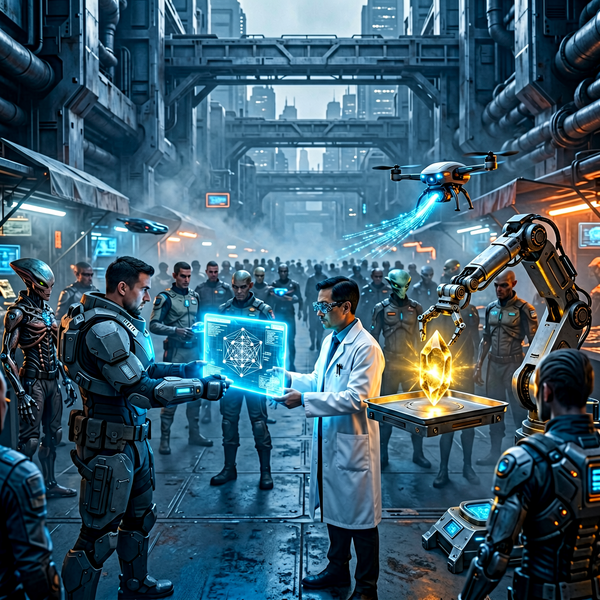
Welcome to temporal capitalism — the economic engine of the Stolen Stream universe. It's not a metaphor there. It's the world's most terrifying asset class.
The Premise: Time as Currency
Let me be clear from the outset: temporal capitalism isn't a thought experiment I cooked up over coffee. It's the foundation of an entire fictional universe — one grounded in real physics, real economic principles, and the uncomfortable question of what happens when technology finally cracks open the fourth dimension the way we cracked open the atom.
In the world of The Stolen Stream, time travel isn't achieved through wormholes, closed timelike curves, or any of the usual sci-fi handwaving. It's a physical, measurable, destructive process. Every chronojump burns through biological time at a rate of roughly 10:1 — for every hour you spend in the past or future, you lose ten hours of your natural lifespan. The mechanism isn't magic. It's entropy, weaponized.
And that's where the economics get interesting.
The Physics: Frame-Dragging, Lense-Thirring, and the Frozen Light Singularity
To understand temporal capitalism, you first have to understand how time travel works in this universe. I'm a storyteller, not a physicist — but I built this system to survive scrutiny.
The key technology is the Frozen Light Singularity (FLS) — a device that exploits a real phenomenon called frame-dragging, predicted by Einstein's general relativity and confirmed by the Gravity Probe B experiment in 2011. Frame-dragging occurs when a rotating massive body literally twists the spacetime around it, dragging inertial frames along for the ride. The Lense-Thirring effect — named for the two Austrian physicists who derived it in 1918 — predicts that a gyroscope near a rotating mass will precess, not because of external torque, but because spacetime itself is spinning.
The FLS takes this principle to its logical extreme. By generating a quantum-locked rotating gravitational field — a "frozen" beam of light bent into a closed loop by extreme gravity — the device creates a localized region where spacetime curvature is severe enough to allow controlled time displacement. Think of it as an orrery made of pure gravity, spinning time itself around a central axis.
But the universe doesn't give you something for nothing. The First Law of Thermodynamics is a jealous god. Displacing your matter through time requires an energy exchange, and the universe balances its books by accelerating your local biological clock. Each jump accelerates your aging relative to the rest of the universe. The 10:1 ratio isn't arbitrary — it's a function of the energy density required to form a stable FLS field, calculated from the stress-energy tensor of the rotating spacetime bubble.
Time dilation, Einstein's special relativity, becomes a tax. You're not just moving through time — you're borrowing against your own lifespan, and the interest rate is usurious.
The Economics: A New Asset Class
So now you have a technology that can transport you through time, but it costs you years of life to do it. What happens next?
A market happens.
In the Stolen Stream universe, time became a tradeable commodity the moment the first FLS device went online. The logic is brutal and elegant:
- Everyone has exactly one finite resource: their lifespan. Some have more (the young), some have less (the elderly, the terminally ill).
- Time travel creates a demand for time. To go back and fix a mistake, to invest in a past market, to retrieve a dead loved one — all of it costs you years.
- Supply and demand apply. If you're twenty years old and healthy, your remaining decades are a liquid asset. You can sell them on the open market to a forty-year-old CEO who needs to jump back and prevent a hostile takeover.
Time exchanges emerged organically. First as black markets — back-alley chronojockeys selling years to desperate clients. Then as regulated exchanges, with ticker symbols, settlement periods, and SEC oversight. A young person in good health could walk into a Time Exchange, sell five years of their lifespan, and walk out a millionaire. The buyer would deposit those years into a "temporal bank account" — essentially a quantum-entangled buffer that stores biological potential energy — and use them to fund their next jump.
The implications are dystopian and fascinating in equal measure.
Temporal Inequality: The New Class Divide
Temporal capitalism doesn't replace traditional capitalism — it layers on top of it, creating a brutally compounding form of inequality.
The rich already live longer. Better healthcare, better nutrition, lower stress. But under temporal capitalism, the rich can literally buy time. A billionaire in their seventies doesn't have to accept mortality — they can purchase decades from young, desperate sellers and keep jumping back to extend their prime indefinitely. The poor, meanwhile, sell their futures for survival, aging prematurely while the wealthy cycle through borrowed decades.
But it gets worse. Because time travel enables retroactive investment. If you have enough time credits to make a jump, you can go back five years, invest in a startup you know will succeed, return to the present, and collect the returns. The time you spent on the jump — say, six months of subjective time costing you five years of lifespan — is dwarfed by the financial gain. The wealthy don't just get longer lives. They get multiple lives, each one leveraged against the last.
This creates a phenomenon I call temporal compounding. In traditional finance, compounding means your money earns interest, and that interest earns interest. In temporal capitalism, your time earns time — and the returns are exponential. A single successful jump retroactively funded can buy enough time credits for two more jumps, which can fund four more, and so on. The ultra-wealthy become effectively immortal, not through biology, but through arbitrage.
The term for those who can no longer afford to participate in the time economy? The Chrono-Locked. They are the new underclass — people trapped in linear time while the rich play hopscotch across decades.
The Cracks in the System: Paradox and Regulation
Of course, any system this powerful creates its own failure modes.
Temporal arbitrage — the practice of exploiting knowledge from the future in past markets — is nominally illegal in most jurisdictions, but enforcement is nearly impossible. How do you prove an investor knew a stock would rise because they saw it rise, rather than because they did good research? The temporal exchanges have tried everything: quantum-entangled audit trails, mandatory chrono-scans before major trades, even a proposed "temporal tax" that would confiscate a percentage of all retroactive gains. Nothing works perfectly.
Then there's the paradox problem. If you go back and change something, you alter the timeline that produced your own knowledge. The FLS technology includes safeguards — quantum decoherence buffers that prevent most direct grandfather paradoxes — but subtle changes ripple forward in ways that are hard to predict. Temporal insurance is a booming industry: policies that compensate you if your future knowledge becomes invalid because someone else changed the past.
And all of this operates on borrowed time — literally. The 10:1 tax means that every jump is a net loss of total human lifespan. The species is slowly burning through its collective future to feed its present desires. Some economists have proposed a Temporal Stewardship Index — a measure of global remaining lifespan — as a replacement for GDP as a metric of true societal health. It's never been adopted. You can guess why.
Why This Matters (Even Though It's Fiction)
I'm a worldbuilder. My job is to construct systems that feel real, that have internal consistency, that make you think about your own world from a new angle. Temporal capitalism does that.
It asks uncomfortable questions: What is a human life worth in market terms? If you could sell years of your life for money, would you? What happens to a society when the most valuable commodity is your own mortality? These aren't questions about the future of technology. They're questions about the present of human nature.
The physics is real — frame-dragging, time dilation, the Lense-Thirring effect. The economics is real — supply, demand, derivatives, arbitrage, compounding inequality. The only fiction is the FLS device itself. But give humanity a working time machine, and temporal capitalism is not just plausible. It's inevitable.
If This Universe Is Your Thing...
I've spent years building the world of The Stolen Stream — the novels, the lore, the rules of temporal physics, and the music that gives it all a soundtrack. It's a story about the people caught in this system: the chrono-locked underclass, the temporal billionaires, the regulators trying to hold back the tide, and the few who ask whether time should be owned at all.
If temporal capitalism intrigues you — if the idea of time as a tradeable, bankable, stealable commodity gets your gears turning — I invite you to dive in.
Visit mesoblackmedia.com to read The Stolen Stream, explore the universe, and experience the soundtrack that brings it to life. The future (and the past) are waiting.
Anthony Frederick is the founder of MesoBlack Media, a creative studio building immersive sci-fi universes through fiction, music, and interactive media. His work explores the intersection of physics, economics, and human nature at the hard edge of speculative fiction. Find him at mesoblackmedia.com or follow @MesoBlack on your preferred platform.