Time Travel Physics Books: 7 Novels That Get the Science Right
Most time travel fiction treats physics as a polite suggestion rather than a set of rules — but the novels on this list take Einstein as seriously as they take their plots. These aren’t books where someone steps into a Victorian phone booth and pops out in ancient Rome. They’re books where time behaves like a phenomenon to be understood, not a magic trick.
Table of Contents
- Why Most Time Travel Stories Get Physics Wrong
- The Books That Do Their Homework
- From Frame Dragging to Temporal Economics
- Where Sci-Fi Meets Physics
Why Most Time Travel Stories Get Physics Wrong
Let’s be honest: the average time travel novel uses the concept as a narrative convenience. Character needs to witness a historical event? Time portal. Needs a do-over? Time loop. The physics is usually hand-waved in a single paragraph of technobabble.
The problem isn’t that these stories are inaccurate — it’s that they’re incurious. They treat time travel as a solved problem rather than as a phenomenon with rules, constraints, and terrifying implications.
The best time travel fiction does the opposite. It starts with physics — relativity, frame dragging, closed timelike curves, quantum entanglement — and asks: if this were real, what would it actually mean?
Tor.com has run excellent pieces on the physics of time travel in fiction, and the consensus among scientifically literate reviewers is clear: the stories that hold up best are the ones where the rules are internally consistent and grounded in actual theoretical physics.
The Books That Do Their Homework
Below are seven novels where the time travel mechanics aren’t just plausible — they’re the whole point. Each book takes a different approach to the physics, from relativistic time dilation to quantum information theory to the economics of temporal manipulation.
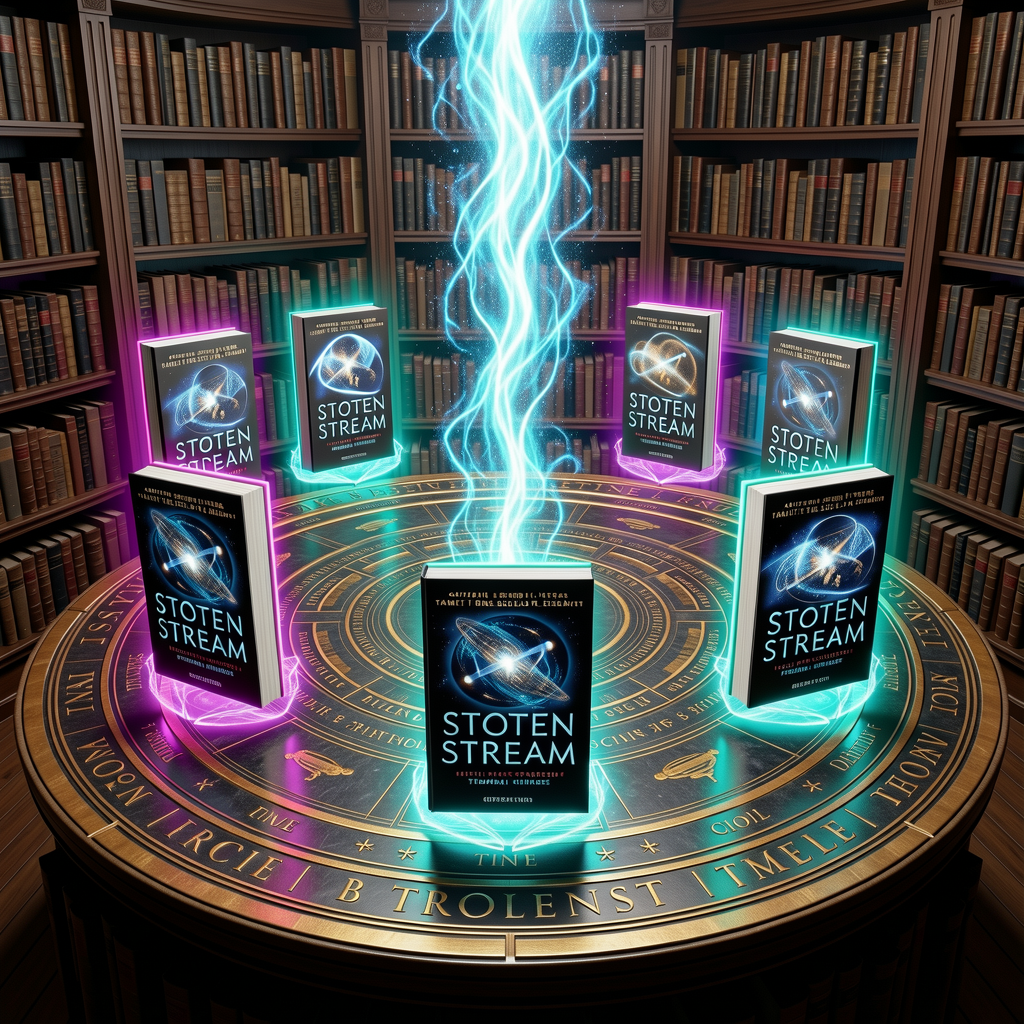
1. The Stolen Stream — Temporal Economics Built on Real Physics
This is the book for readers who want time travel with rules that matter. The Frozen Light Singularity technology doesn’t just enable temporal jumps — it imposes a hard constraint: the 10:1 temporal toll. Travel 10 years forward, and you lose 1 year of your biological lifespan. This isn’t arbitrary; it’s derived from speculative physics that treats time as a field that can be manipulated at a cost proportional to the displacement.
What makes The Stolen Stream essential reading for physics-minded sci-fi fans:
- Conservation of lifespan. The 10:1 ratio means time travel is a resource-allocation problem, not a narrative shortcut. Every jump is a tradeoff that the characters must calculate.
- Economic implications. The book explores what happens when “time is money” becomes literal: class structures built around temporal access, black markets for unauthorized jumps, regulatory frameworks for temporal commerce.
- Frozen Light Singularity. The enabling technology is treated with scientific rigor — it’s not magic, it’s a phenomenon with discoverable rules and engineering constraints.
Protagonist Kai Eschendorf navigates this world not as a physicist, but as someone caught in its economic machinery — which makes the physics feel even more real. You don’t need to understand the science to feel its weight.
The book also comes with a 19-track dark synthwave soundtrack, a multimedia approach that adds dimension to the temporal atmosphere. The Stolen Stream is available at mesoblackmedia.com.
2. The Time Ships by Stephen Baxter
The authorized sequel to H.G. Wells’ The Time Machine — and the rare sequel that surpasses the original. Baxter, a mathematician and engineer, takes Wells’ premise and applies actual modern physics. The result involves multiple timelines, a war fought across the multiverse, and a version of time travel that respects general relativity. The Dyson sphere sequence alone is worth the read.
3. Tau Zero by Poul Anderson
The ultimate relativistic time travel novel. A starship’s deceleration system fails, forcing it to accelerate closer and closer to light speed. Time dilation means the crew experiences months while the universe outside ages billions of years. Anderson does the math — the Lorentz factor, the cosmic timescales — and the result is one of the most existentially terrifying novels in the genre.
4. The Light of Other Days by Arthur C. Clarke and Stephen Baxter
Not time travel in the traditional sense — but a technology that lets people see anywhere in the past, in real time, with no ability to change it. The novel explores what happens to society when all secrets become visible: no locked room, no hidden crime, no historical mystery can remain hidden. The physics is wormhole-based and rigorously justified. The implications are devastating.
5. Timescape by Gregory Benford
A novel written by an actual astrophysicist, and it shows. Scientists in 1998 attempt to send a warning back to 1962 about an ecological catastrophe — using tachyons and quantum mechanics. Benford treats the physics with academic seriousness and the human drama with equal weight. This won the Nebula Award and the John W. Campbell Memorial Award for a reason.
6. The Quantum Thief by Jean le Flambeur (Hannu Rajaniemi)
Rajaniemi holds a PhD in string theory, and his debut novel reads like a heist thriller set inside a physics textbook — in the best way. Time is a resource called “gevulot,” privacy is a protocol, and death has been commodified. The time mechanics are genuinely novel: quantum entanglement, computronium, and the “exomemory” that lets characters exist across multiple moments simultaneously.
7. Spin by Robert Charles Wilson
One night, the stars disappear. Earth is encased in a membrane that slows time outside to a crawl — one second outside equals nearly four years inside. The novel explores the physics of the “Spin membrane,” the astrophysical implications of a temporal shield, and — most importantly — the human cost of knowing the sun will go nova in a generation. Winner of the Hugo Award.
From Frame Dragging to Temporal Economics
What unites these seven books is a commitment to consequences:
- Relativistic frame dragging in Tau Zero isn’t background color — it’s the entire plot.
- Tachyonic communication in Timescape isn’t technobabble — it follows from equations Benford actually published.
- The 10:1 temporal toll in The Stolen Stream isn’t an arbitrary rule — it’s a conservation law that shapes every decision in the narrative.
These books don’t ask you to suspend disbelief. They ask you to extend it — from known physics to plausible speculation.
Where Sci-Fi Meets Physics
The relationship between physics and fiction is two-way. Physicists like Kip Thorne (who consulted on Interstellar) have used science fiction as a sandbox for exploring ideas that can’t yet be tested experimentally. And the best time travel novels — the ones on this list — return the favor by taking those ideas seriously.
Goodreads listopia rankings consistently place these titles at the top of reader-voted “hard sci-fi time travel” lists. The common thread: readers reward books that respect their intelligence and don’t cheat on the rules they establish.
Why Trust This List
I’ve read all seven of these books — some multiple times. The selection criteria: the time travel mechanics must be grounded in actual physics (relativity, quantum mechanics, cosmology), internally consistent, and essential to the story. No “it was all a dream” endings. No paradox-resolution by handwave. Just novels that treat time as a real phenomenon worthy of serious artistic engagement.
Related Posts
- Best Time Travel Sci-Fi Books: 11 Novels That Bend Time
- Mind-Bending Sci-Fi Books: 13 Stories That Will Rewire Your Brain
- 8 Hard Sci-Fi Books Like Project Hail Mary
Author: Derek | MesoBlack Media