ARK-7 and the Fragments: The Satellite That Records Every Possible Future

The Satellite That Shouldn't Exist
The Archive Satellite launched in silence. Private consortium rockets don't make headlines. The payload was listed as "quantum data relay for deep-space communication." The mission lasted forty-seven seconds. Then the signal collapsed. The Archive Satellite was declared a ghost — dead weight drifting through the black.
Ten years later, debris struck the corpse. Something inside it opened its eyes.
The Transmission That Broke the World
The Archive Satellite began broadcasting on a frequency that bypassed every encryption protocol on Earth simultaneously. For exactly three seconds, every screen on the planet displayed a single sentence: "THE FUTURE IS NOT ONE LINE."
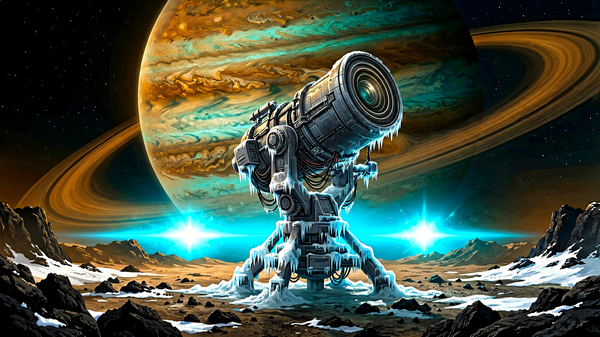
When the signal was traced, The Archive Satellite had moved. It achieved a stable orbit around the Moon — a maneuver its propulsion system should never have been capable of performing.
The consortium that built The Archive Satellite — the Aetius Group — dissolved years prior. Members scattered. Some died. Some vanished. Some founded ARKIVE GENETICS. A single twenty-four-seven signal monitor remained operational in a basement office that technically does not exist. When The Archive Satellite reawakened, the monitor caught a second message: "DON'T FIND THE FRAGMENTS. THEY FIND YOU."
The Recording of Every Possible Future
The Archive Satellite was designed to record quantum states of possible futures. It does not predict the timeline. It captures branch points — moments where a single decision fractures reality into something entirely new. The satellite projects these futures as data shards called Fragments.
A Fragment manifests as a shard of obsidian threaded with gold veins, hovering weightless. Upon touch, the experiencer lives an entire timeline in what the outside world registers as exactly three seconds. Complete sensory, emotional, and physical immersion. Twenty-one Fragments are known. Twenty-one possible futures. Twenty-one complete stories.
The Archive Satellite did not stop at twenty-one. It is still transmitting. The signal is growing stronger.
The Cost of Knowing
Touching a Fragment leaves marks. The experiencer retains memories from the future they lived — skills never learned, languages that do not exist, the faces of people they have never met. The effects are cumulative. The more Fragments a person experiences, the less connected they become to their original timeline. The Archive calls this Timeline Dissociation Syndrome. The victims call it the blur.
The Constant Across Every Future
Across every Fragment timeline, one role recurs: a person searching for the truth about ARK-Sometimes a data analyst. Sometimes a salvage specialist. Sometimes a memory broker. Different face, different life — but the same consciousness, the same desperate question.
The Collector has touched more Fragments than anyone. They no longer remember which timeline they originally belonged to. Their search is not curiosity. It is a frantic attempt to find their way home.
The Archive Satellite was not the first attempt. The technology predates the satellite by at least forty years. The Archive's original charter remains classified. And the Fragments are not recordings — they are instructions. Someone designed The Archive Satellite to scatter possible futures across the planet. To give humanity a choice.
The signal is still transmitting. The future is not one line. It never was.
|
More from the Fragment universe: Fragment Universe | Fragment Book 1 | Fragment Book 2
Related: Complete Lore Guide 11 · Hidden Details And Symbolism 2