Scar Zone Bazaar Guide: The Multi-Era Marketplace
Share

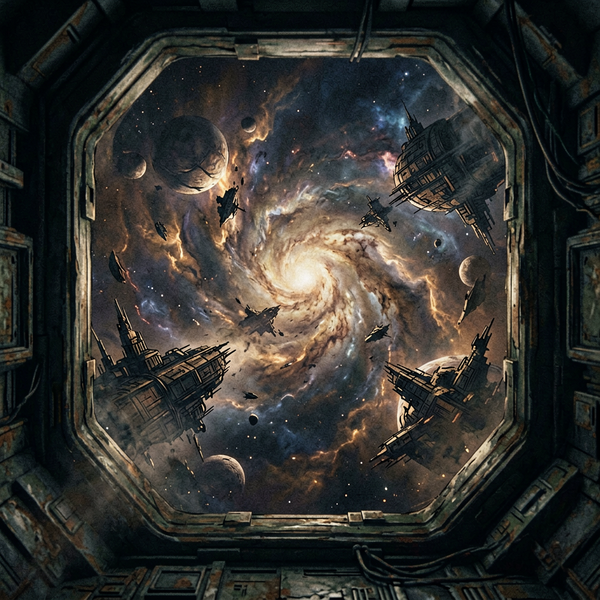
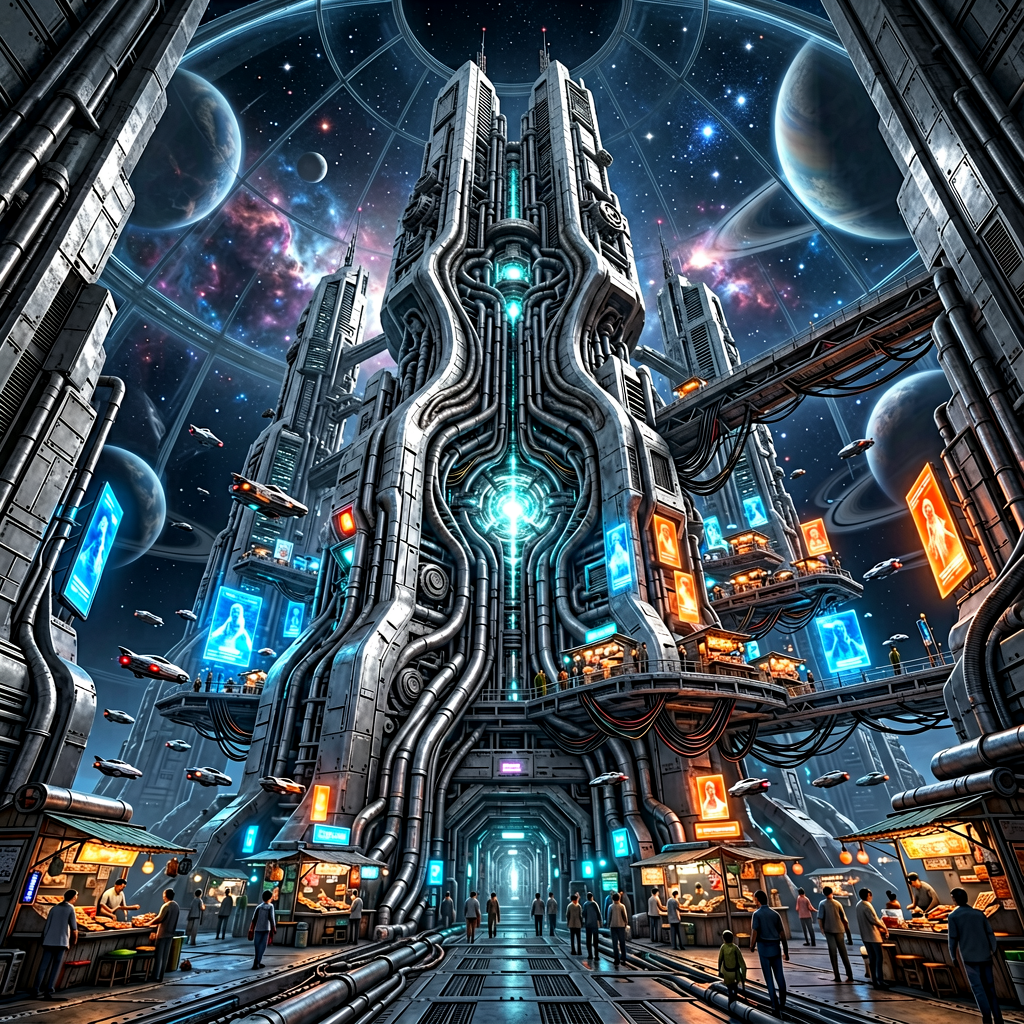
In the heart of the Scar Zone — the 40-square-kilometer wound in Worcester, Massachusetts where time has broken — there is a market that transcends centuries. The Scar Zone Bazaar is a multi-era trading post where merchants from the 18th, 20th, and 23rd centuries conduct business side by side, where the currency is not gold or crypto but chronal credit, and where a bad deal can cost you years you will never get back.

This is not a tourist destination. This is the beating heart of temporal capitalism — and it is the most dangerous marketplace in human history.

Location and Geography

The Bazaar is situated at the intersection of three major temporal strata within the Scar Zone: a fragment of 1880s industrial Worcester, a pocket of 1990s suburban decay, and a splinter of a 23rd-century city that may or may not exist yet. These three layers overlap physically, creating a space where a Victorian cobblestone street runs directly into a neon-lit arcade from a future century.

The Bazaar has no fixed boundaries. It expands and contracts as the Scar Zone's chronal fields shift — sometimes hourly. Merchants who set up shop on solid ground one day may find their stall hanging over Memory Canyon the next. The only permanent structures are the Brass Pillars, six-meter-tall clockwork anchors driven into the bedrock by the Eschendorf family in 2003 to stabilize the local timeline.

The Merchants of Every Era

The Bazaar's vendors come from across the timeline, drawn by the same force that pulls travelers to any market: profit.

  • **The Victorian Antiquarians** (circa 1840–1890): Dressed in frock coats and carrying brass chronometers, these merchants trade in objects that have gained chronal resonance from exposure to the Scar Zone. A pocket watch that has absorbed time from three centuries is worth more than one that has only seen a single lifetime.
  • **The Future-Tech Syndicate** (circa 2170–2250): Beings whose origins are uncertain — their faces obscured by holographic veils, their wares including power cells that never drain and fabrics that self-repair at the molecular level. They accept payment only in **biological time**: hours, days, years extracted via compact hand terminals.
  • **The Scavengers of Now** (present-day): Locals who venture into the Scar Zone to recover artifacts that have fallen through temporal cracks — a 19th-century letter that arrived in a 2024 mailbox, a 23rd-century data chip found in a parking lot. They trade these finds for money, medicine, or passage out of the Zone.
  • **The Eschendorf Representatives**: Dressed in sharp suits that look identical across every era, these agents monitor the Bazaar for violations of the family's temporal monopoly. They buy up the most valuable chronal assets and enforce the **10:1 toll** on anyone attempting unauthorized jumps.

Temporal Arbitrage: The Art of Buying Time

The most sophisticated — and most dangerous — trade in the Bazaar is temporal arbitrage: buying time when it is cheap and selling when demand peaks, without ever jumping yourself.

The mechanics are simple in theory. Time in periods of low demand (e.g., the Great Depression, when few could afford to travel) is priced lower per year than time in high-demand periods (e.g., the Renaissance, when artists and scientists would trade fortunes for more working years). A trader with access to chronal credit can purchase future time from a depressed era, hold it in storage via frozen light certificates, and sell it at a premium when demand surges.

The risk: time is a perishable asset. Stored chronal signatures degrade at approximately 0.3% per year without proper crystal lattice maintenance. A trader who holds too long may find their inventory has decayed to uselessness — while their debt (borrowed years that must be repaid) continues to accrue.

Temporal arbitrage is the purest expression of temporal capitalism: the rich get richer by managing time they never personally spend, while the poor sell minutes and hours just to survive the next day.

The Decay Haze

No guide to the Bazaar is complete without mentioning the atmospheric condition that defines it. The Decay Haze is a permanent, shimmering fog that blankets the market — a prismatic mist caused by microscopic gravitational lensing events suspended in the air.

The Haze has three effects on visitors:

1. Visual distortion: At distances beyond 200 meters, objects appear to stretch, duplicate, or vanish entirely. A merchant's stall might appear to be selling apples in one direction and rifles in another. 2. Temporal interference: Digital devices — phones, watches, GPS units — malfunction unpredictably. The Haze's chronal particulates confuse quartz oscillators and corrupt timekeeping circuits. 3. Biological accumulation: Inhaling the Haze is actively dangerous. The chronal particulates lodge in lung tissue and accelerate cellular aging along the familiar 10:1 toll curve. Filtered breathing apparatus is mandatory for any stay longer than four hours.

Veteran Bazaar merchants develop a distinctive cough — the "Haze Hack" — and age noticeably faster than their chronological years would suggest. It is the cost of doing business in broken time.

Memory Canyon: Tourist Attraction and Grave

At the eastern edge of the Bazaar, the ground drops sharply into Memory Canyon — a kilometer-long fissure where past time strata are exposed like sedimentary rock. The Canyon is the Bazaar's most popular attraction and its most solemn grave site.

Tourists descend via rope ladders and cable cars, walking through layers of history: the 1950s linoleum floor, the 1890s cobblestones, the pre-colonial soil at the bottom. Each layer plays back its memories — sounds, smells, fragments of speech — as visitors pass through. A traveler might hear a 1923 argument between two factory workers, the hoofbeats of a 1770s courier, or the hum of a 2090s hover-transit system.

But the Canyon is also where the dead are buried — not physically, but chronally. When a time traveler dies with unpaid temporal debt, their chronal signature can become trapped in the Canyon's strata, repeating the final moments of their life in a loop that never fades. Locals call these trapped souls Echoes, and the Canyon is full of them.

The Ruins of Tomorrow

On the western edge of the Bazaar, past the Brass Pillars, lie the Ruins of Tomorrow — structures that exist in a state of chronal superposition, simultaneously brand-new and crumbling to dust. The Ruins are buildings that belong to probable futures that may or may not come to pass, and they are unstable.

Walking through the Ruins is deeply disorienting. A door that opens onto a clean hallway in one moment leads to a collapsed ceiling in the next. Visitors report seeing their own faces in windows — older, younger, scarred, healthy — depending on which future timeline they are glimpsing.

The Ruins are a direct result of the Frozen Light Singularity's damage to the local timeline. They are a glimpse of what happens when causality breaks down entirely: a world where the past, present, and future coexist without hierarchy, and nothing is certain except that entropy always wins.

Why the Bazaar Matters

The Scar Zone Bazaar is the physical manifestation of everything The Stolen Stream explores. It is a place where hard sci-fi time travel is not a theoretical concept but a commercial reality — where merchants haggle over centuries, where time dilation fiction meets economics, and where the Eschendorf family's 400-year monopoly on frozen light technology plays out in real time.

Every transaction in the Bazaar is a microcosm of temporal capitalism. The rich buy years; the poor sell days. The Haze ages everyone. The Canyon remembers everything. And the Ruins show what happens when the system goes unchecked.

[Read The Stolen Stream →] Full audiobook + ebook bundle. 14-track soundtrack. $19.99.

Read more