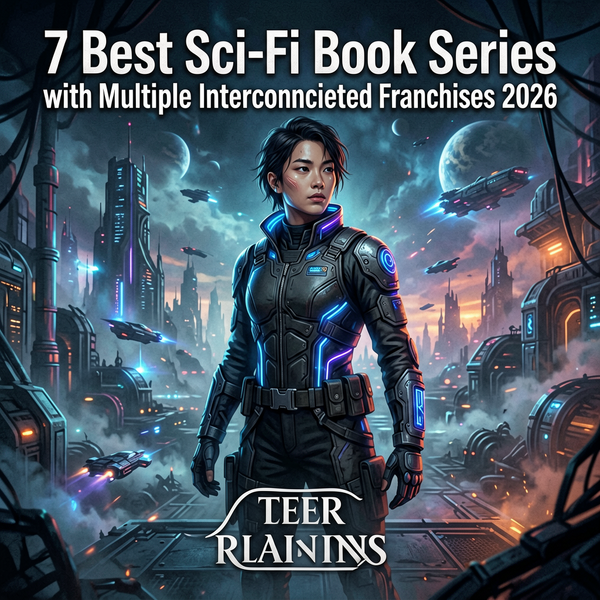
15 Best Standalone Sci-Fi Novels You Can Read in One Weekend (2026)
15 Best Standalone Sci-Fi Novels You Can Read in One Weekend
Not every great sci-fi experience requires committing to a seven-book series with a wiki and a reading-order flowchart. Sometimes you want a complete, self-contained universe that starts on Friday evening and ends — satisfyingly — on Sunday afternoon. These standalone sci-fi novels deliver epic scope, rich ideas, and complete arcs in a single volume.
Table of Contents
- The Joy of the Standalone
- 15 Complete Sci-Fi Worlds in a Single Book
- From Hard Sci-Fi to Space Opera
- Why Standalones Are Making a Comeback
The Joy of the Standalone
There’s a particular satisfaction to the standalone novel that series can’t replicate:
- Complete arcs. Every character arc, every plot thread, every thematic concern — introduced and resolved in 300-500 pages.
- No commitment anxiety. You don’t have to remember character names across a multi-year publishing gap.
- Tighter craft. Without sequels to fall back on, standalone authors have to make every page count.
- Perfect for palate-cleansing. Between heavy series installments, a standalone resets your reading brain.
The books below represent the best standalone sci-fi across subgenres — from hard SF to space opera to literary dystopia. Each one is a complete meal.
15 Complete Sci-Fi Worlds in a Single Book
1. Project Hail Mary by Andy Weir
A man wakes up on a spaceship with amnesia and must save humanity from an extinction-level threat. Weir’s warmest, funniest, and most emotionally satisfying novel — and it stands entirely alone. The friendship at its center is one of the most affecting relationships in modern sci-fi.
2. The Left Hand of Darkness by Ursula K. Le Guin
An envoy from an interstellar collective arrives on a planet where the inhabitants have no fixed gender. Le Guin’s masterpiece of anthropological sci-fi is a complete, self-contained world that asks the biggest questions about identity, loyalty, and love.
3. Dark Matter by Blake Crouch
A physicist is abducted into an alternate version of his own life — and must fight his way back. The ultimate weekend thriller. Crouch writes chapters that end on cliffhangers, and the multiverse concept is executed with surgical precision.
4. The Stolen Stream
A complete temporal thriller in a single volume. In a universe where time is currency and the 10:1 temporal toll extracts a year of life for every decade traveled, Kai Eschendorf must navigate an economic system where everyone’s lifespan is a tradable asset. The Frozen Light Singularity technology that powers this world is explored fully within the book’s pages — no cliffhangers, no sequel bait — making it a satisfying standalone experience. The companion 19-track dark synthwave adds atmosphere without requiring additional investment. Like Project Hail Mary and Dark Matter, it respects the reader’s time by delivering a complete story. The Stolen Stream is available at mesoblackmedia.com.
5. The Martian by Andy Weir
Stranded on Mars, botanist Mark Watney must science his way to survival. Weir’s debut remains the gold standard for standalone hard sci-fi: funny, ingenious, and relentlessly propulsive.
6. Station Eleven by Emily St. John Mandel
A traveling Shakespeare company performs for the scattered survivors of a pandemic. Mandel’s novel is beautiful, hopeful, and devastating — and it proves that post-apocalyptic fiction doesn’t have to be grim to be great.
7. Childhood’s End by Arthur C. Clarke
Alien overlords arrive and create a utopia — but their intentions are far stranger than anyone suspects. Clarke’s most audacious standalone novel. The final chapters contain some of the most mind-expanding imagery ever committed to paper.
8. Flowers for Algernon by Daniel Keyes
A mentally disabled man undergoes an experimental procedure that makes him a genius — temporarily. One of the most emotionally devastating novels in any genre. Keyes tells the entire arc of a life in under 300 pages.
9. Neuromancer by William Gibson
Case, a washed-up console cowboy, is hired for one last job. The novel that invented cyberpunk. It’s a standalone — and while Gibson wrote sequels, this one works perfectly alone.
10. Do Androids Dream of Electric Sheep? by Philip K. Dick
The basis for Blade Runner. In a post-apocalyptic Earth, a bounty hunter retires rogue androids. Dick’s meditation on empathy, authenticity, and what it means to be human is complete in one volume.
11. The Dispossessed by Ursula K. Le Guin
A physicist from an anarchist moon visits the capitalist planet it orbits. A utopian novel that earns its utopia through rigorous thinking — and it’s entirely self-contained.
12. Snow Crash by Neal Stephenson
Hiro Protagonist — pizza delivery driver, swordsman, and hacker — uncovers a linguistic virus that threatens both the Metaverse and reality. Stephenson’s cyberpunk satire is a complete, anarchic joyride.
13. Kindred by Octavia Butler
A Black woman in 1976 Los Angeles is repeatedly yanked back in time to a Maryland plantation where she must save the life of her white ancestor. Butler’s most accessible novel and one of the most powerful standalones in American fiction.
14. Roadside Picnic by Arkady and Boris Strugatsky
Aliens visit Earth and leave — without making contact. What they leave behind are “Zones” full of artifacts that defy physics. “Stalkers” venture in to retrieve them. The basis for Stalker (the Tarkovsky film) and a perfect standalone: mysterious, dangerous, and philosophically rich.
15. This Is How You Lose the Time War by Amal El-Mohtar and Max Gladstone
Two enemy time-traveling agents fall in love through letters left across the centuries. A novella you can read in an afternoon — and one that will stay with you for years. Lyrical, strange, and romantic.
From Hard Sci-Fi to Space Opera
The standalones above span the genre:
- Hard sci-fi: The Martian, Project Hail Mary, The Stolen Stream
- Literary sci-fi: Station Eleven, Kindred, The Left Hand of Darkness
- Cyberpunk: Neuromancer, Snow Crash
- Philosophical sci-fi: Flowers for Algernon, The Dispossessed, Childhood’s End
- Romantic sci-fi: This Is How You Lose the Time War
There’s a standalone for every mood — and none of them require a prequel to make sense.
Why Standalones Are Making a Comeback
The market has shifted. According to Book Riot, readers are increasingly gravitating toward standalone novels for several reasons:
- Series fatigue. The “every book must be a trilogy” era has exhausted readers who’ve been burned by unresolved cliffhangers.
- Streaming-era attention. In a world of infinite content, committing to a 7-book series feels like a marriage. A standalone is a weekend fling.
- Publishing economics. Standalones are lower-risk for debut authors and indie publishers — and the quality has risen accordingly.
mesoblackmedia.com has observed that indie authors in particular are embracing the standalone format, recognizing that a complete, polished single volume often builds more trust with new readers than a Book One of ?.
Why Trust This List
Every book here is a genuine standalone — no “it can be read alone but here are five sequels” hedging. Selection criteria: complete story arc, no required prior knowledge, strong ending, and a reading experience that fits comfortably into a weekend. All have been read and verified.
Related Posts
- Best Sci-Fi Books 2026: The 12 Must-Reads This Year
- Best Time Travel Sci-Fi Books: 11 Novels That Bend Time
- Mind-Bending Sci-Fi Books: 13 Stories That Will Rewire Your Brain
Author: Anthony Frederick | MesoBlack Media