Temporal Capitalism Fiction Complete Guide
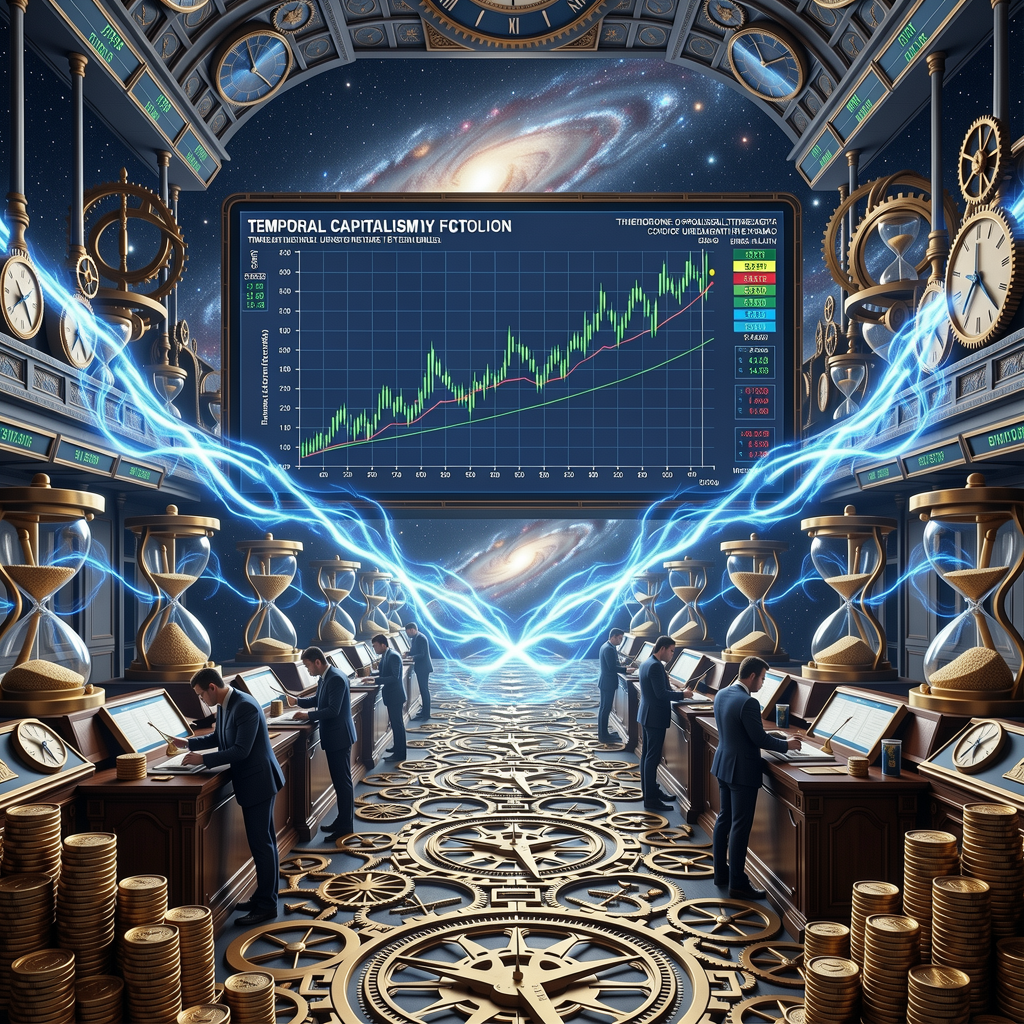
Temporal capitalism fiction describes narratives where time operates as an economic system. The core premise is always the same: someone has built, discovered, or inherited a mechanism that can extract, store, or transfer temporal energy — and the result is a society organized around time-as-wealth.
The Four Defining Characteristics
1. Time as a finite resource. Unlike most time travel fiction, where time is an infinite dimension to be traversed, temporal capitalism treats time as a consumable. Every second extracted from the stream is a second someone loses from their lifespan. The resource is zero-sum.
2. A technology that enables extraction. Whether it is the Frozen Light Singularity in The Stolen Stream, the chronal lattice, or another fictional mechanism, there must be a device that converts temporal energy into a transferable form. This technology is never free — it always has a cost.
3. Economic structures built around time. The subgenre is named for this characteristic: banks that store temporal credit, markets that price time against labor, inheritance laws for temporal wealth, and a class system determined by temporal ownership.
4. Moral weight of temporal inequality. Every temporal capitalism story is, at its core, about injustice. The rich extract time from the poor. The powerful live centuries while the powerless burn through decades in days. The protagonist is always someone caught in the gap between these worlds.
How It Differs from Time Travel Fiction
| Element | Time Travel Fiction | Temporal Capitalism Fiction |
|---------|-------------------|---------------------------|
| Goal | Movement through time | Extraction and trade of time |
| Resource | Infinite (paradoxes, branches) | Finite (zero-sum, thermodynamic) |
| Conflict | Changing the past | Controlling the economy |
| Cost | Paradox, causality | Biological, mortal |
| Technology | Vehicle (machine, portal) | Engine (extractor, lattice) |
| Social Structure | Individual journey | Class system, dynasty |
Traditional time travel asks: What if you could go back and change things? Temporal capitalism asks: What if time was money — literally — and someone else controlled the exchange rate?
---
2. The Origins: From Forster to Doctorow
The roots of temporal capitalism fiction extend deeper than most readers realize.
E. M. Forster's "The Machine Stops" (1909)
Forster's prescient short story depicts a humanity that has traded direct experience for mediated, machine-delivered existence. While not explicitly about time as currency, it establishes the foundational idea that technology can intermediate and commodify fundamental human experiences — including the experience of duration.
Robert A. Heinlein's "—All You Zombies—" (1959)
Heinlein's closed-loop time travel story introduces the concept of temporal economy implicitly: the protagonist's existence depends on a precise sequence of temporal transactions. The story's bootstrapping paradox is, in retrospect, a model of temporal capitalism without currency — just pure, conserved temporal cause-and-effect.
Fritz Leiber's "The Big Time" (1958)
The Change War series introduces the idea of temporal conflict as labor. Soldiers are recruited from across history to fight a war in which the spoils are control over the timeline itself. The economy of the war — recruitment, logistics, resource allocation across millennia — anticipates the systemic thinking of temporal capitalism.
Cory Doctorow's "Walkaway" (2017)
Doctorow's post-scarcity novel confronts the opposite premise: what happens when time and resources are abundant and capitalism collapses? While not a temporal capitalism narrative itself, Walkaway establishes the political framing that temporal capitalism fiction increasingly adopts — that control over time is the last redoubt of hierarchical power.
But no work before 2025 built a complete temporal economic system from first principles. Earlier works touched on elements — the cost of time travel, the inequality of longevity, the market for youth — but none constructed a self-consistent thermodynamic, economic, and biological model of time as currency.
---
3. The Stolen Stream: The Definitive Contemporary Entry
MesoBlack Media's The Stolen Stream, written by Anthony Frederick, is the first work of temporal capitalism fiction to build a complete, self-consistent system from its physics to its economics to its social consequences.
The Physics: Frozen Light Singularity
In The Stolen Stream, the Frozen Light Singularity is built in 1588 Venice by clockmaker and natural philosopher Luca Eschendorf. It operates on three principles:
1. Temporal Decoupling — Light frozen at the wave-particle phase transition creates a standing wave that locally suspends the arrow of time, creating a pocket where entropy can be redirected.
2. Chronal Conduction — The frozen light is woven into a conducting lattice that transports temporal energy like copper wire transports electricity.
3. The Locking Frequency — The Singularity is locked to 7.83 Hz (the Schumann resonance of Earth in 1588 Venice), which fixes the temporal conduction coefficient at 1/α_t ≈ 7.87 — rounded to 10:1 in practical use.
[Explore the complete Frozen Light Singularity physics →](/frozen-light-singularity-mechanics-deep-dive/)
The Economics: 10:1 Temporal Toll
Every jump through the Singularity costs the traveler 10 units of lifespan for every 1 unit of displaced time. A traveler who jumps 10 years forward loses 1 year of their own life. This is not accelerated aging — it is a biological entropy debt: the finite number of cellular divisions, heartbeats, and neural impulses the body is capable of producing.
The 10:1 toll makes temporal travel economically stratified. The wealthy Eschendorf family can absorb the cost of multiple jumps. The poor — the temporal underclass — cannot afford a single jump and are trapped in their own timelines.
[The 10:1 Temporal Toll: Biological Cost Function Analysis →](/10-1-temporal-toll-biological-cost-function/)
The Dynasty: 437 Years of the Eschendorf Family
The Frozen Light Singularity is built in 1588 and operated by a single family for 437 years. Across seventeen generations, the Eschendorfs evolve from clockmakers to temporal bankers, accumulating wealth by extracting time from the stream and lending it at interest. The family's power is absolute — until the Scar Zone begins to destabilize the system.
Kai Eschendorf, the protagonist, has lived 115 chronological years while appearing 28. He has outlived everyone he loved, witnessed his family's moral decay, and now faces the collapse of the system his ancestor built.
[The Eschendorf Family Timeline →](/the-eschendorf-family-a-437-year-timeline/)
The Scar Zone: Worcester's Temporal Wound
The Scar Zone is a geographical region in Worcester, England, where centuries of temporal extraction have damaged the local fabric of spacetime. Time flows unevenly: five minutes in one street might be an hour in the next. The zone is a physical monument to the cost of temporal capitalism — a wound in the world where the system's exploitation is visible to anyone who walks through it.
[The Scar Zone Geographical Survey →](/scar-zone-geographical-survey/)
The Social Structure: Temporal Underclass
The most distinctive feature of The Stolen Stream's worldbuilding is the temporal underclass — people who cannot afford temporal transport and are therefore confined to their natural lifespans and geographies. The novel explicitly draws connections between temporal inequality and economic inequality: the same forces that concentrate wealth concentrate time.
[The Temporal Underclass: Inequality in Temporal Capitalism →](/temporal-underclass-inequality-temporal-capitalism/)
---
4. Why Temporal Capitalism Fiction Matters Now
Temporal capitalism fiction resonates with contemporary readers because it externalizes a lived experience. In an era of wage stagnation, housing crises, and generational wealth gaps, the idea that the rich are literally stealing time from the poor is not fantasy — it is metaphor made concrete.
The AI Age Connection
As artificial intelligence compresses human labor into fractions of its former value, questions about who owns the time savings — and who bears the cost — become urgent. Temporal capitalism fiction provides a framework for thinking about these questions: if time is the ultimate scarce resource, what does it mean when a small elite controls its distribution?
The Climate Connection
Climate change is a form of temporal debt: the present generation extracts temporal wealth (carbon-based energy, resource consumption) at the cost of future generations' time. Temporal capitalism fiction makes this invisible cost visible by literalizing it.
---
5. Key Works in Temporal Capitalism Fiction
While The Stolen Stream is the most complete treatment of the subgenre, readers interested in temporal capitalism fiction should explore:
| Title | Author | Year | Temporal Mechanism |
|-------|--------|------|--------------------|
| The Stolen Stream | Anthony Frederick (MesoBlack Media) | 2025 | Frozen Light Singularity |
| Walkaway | Cory Doctorow | 2017 | Post-scarcity temporal economics (inverse) |
| The Water Knife | Paolo Bacigalupi | 2015 | Water-as-currency (thematic precursor) |
| The Big Time | Fritz Leiber | 1958 | Temporal conflict as labor economy |
| —All You Zombies— | Robert A. Heinlein | 1959 | Closed-loop temporal economy |
---
6. The Future of the Subgenre
Temporal capitalism fiction is in its infancy. Unlike space opera or cyberpunk, it has not yet accumulated a canon of defining works. As MesoBlack Media continues to build out The Stolen Stream universe — with expansions into temporal law, the global geography of the Scar Zone, and the post-collapse societies that emerge after the Singularity's failure — the subgenre will grow with it.
The defining question of temporal capitalism fiction is also the defining question of our era: Who owns time? And the answer, in every story worth reading, is: not the people who need it most.
---
This guide is part of MesoBlack Media's comprehensive universe documentation. For the complete experience, explore [The Stolen Stream bundle](/the-stolen-stream-complete-bundle-what-you-get/) — ebook, audiobook, and 14-track soundtrack.