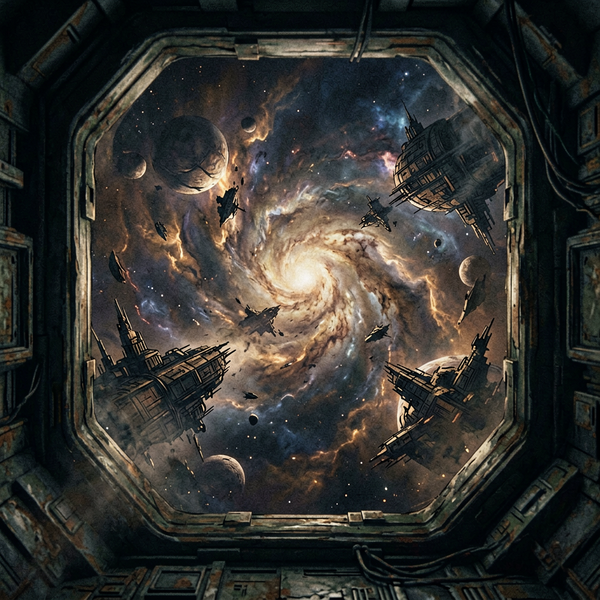
Climbing the Tower — Trials and Transcendence in the Labyrinth of Names

The Tower's Judgment: Trials of Coherence
The Tower of Names does not merely rise from the scarred plains of the Lower Expanse—it redefines existence itself. Its obsidian spires pierce the Chronosynclastic Infundibulum, that perpetual storm of fractured time and forgotten history, demanding a price from every soul who dares approach.
The False Promise of Ascent
The consensus among the Broken—those few who returned shattered from the lower levels—is brutally simple: the Tower judges not strength, but coherence. Every upward step forces an aspirant to shed accumulated falsehood, borrowed identity, and manufactured memory. The structure itself breathes on the psychic residue of those who failed, powering the ever-shifting architecture of higher tiers with the ghosts of ambition.
The Lower Floors: Psychic Erosion
The Trial of Echoes awaits on the first ascent, often consuming decades from a single climbing party. These initial levels are not physically demanding; they are psychically corrosive. The architects—perhaps the long-vanished First Nomenclators—engineered these zones to dismantle the concept of "I" itself.
Aspirants navigate personalized hallucinations: perfectly rendered environments from their past, populated by spectral reflections of loved ones who died before the Tower's shadow touched them. These echoes whisper temptations—retreat, forget the burden of ambition, accept a comfortable, pre-written fate. Failure yields Erosion, a fate worse than death. The subject's foundational memories disintegrate, leaving behind a hollow shell called a Placeholder. These empty vessels become fodder for the Tower's defenses or, more tragically, willing servants to the lower administrative entities.
The first true gate, guarded by automatons forged from solidified regret, is the Seal of Provenance. To pass, an aspirant must present a True Name—a designation unburdened by lineage, societal expectation, or self-deceit. Powerful warlords and celebrated scholars break here, discovering the names they carried across the Expanse were merely useful labels, not the core of their being. Only those who can articulate an origin point utterly unique to their internal reality earn passage.
The Mid-Levels: Architects of Self
Beyond the Seal of Provenance, the geometry becomes actively hostile. The mid-levels host the Chronosynclastic Infundibulum's most potent temporal anomalies. Here, the Trials shift from memory-stripping to existential reconstruction.
The most notorious challenge is the Labyrinth of Contingency. This space forces every decision an aspirant has made throughout their life to play out simultaneously. Confronting the realities of paths not taken becomes the crucible. If an aspirant regrets a past action—a betrayal, a cowardice, a moment of weakness—the Labyrinth forces them to inhabit the consciousness of the alternate self who acted differently. The goal is not mastery over these alternate realities, but acceptance of them.
For those seeking deeper understanding of the First Nomenclators who engineered these tests, explore . To understand how the Broken have documented their harrowing experiences, read .
The Final Truth
The Tower of Names does not offer transcendence—it demands authenticity. The aspirant who reaches the apex does not gain power over reality; they become real enough to survive it. Every step upward is a death of a former self, and every death is a birth into greater coherence. The question is not whether you can climb, but whether you are willing to become someone worth finding at the top.
More from the Tower Of Names universe: Tower Of Names Universe | Tower Of Names Book 1 | Tower Of Names Book 2
Related: Archive Of Echoes Tower Of Names Guarded Chamber · Ton Tower Of Names Mesoblack Media Guide · Tower Lore Deep Dive