Kai Eschendorf: The Man Who Built the Synchronizer and Broke Temporal Capitalism

Share
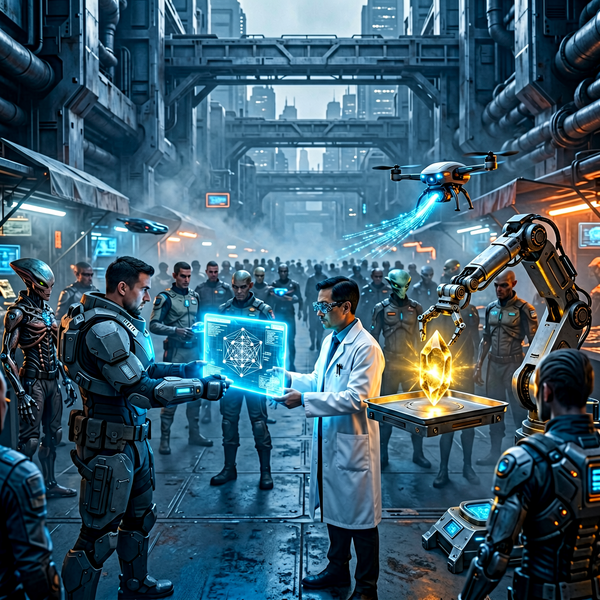
Kai Eschendorf standing before the Synchronizer in The Stolen Stream

Kai Eschendorf: The Man Who Built the Synchronizer and Broke Temporal Capitalism

Kai Eschendorf is 115 years old biologically and 437 years old chronologically. That gap — 322 years of subjective time experienced but never aged through — is not a quirk of his biology. It is the central crime of temporal capitalism, and Kai is both its victim and its most dangerous opponent.

In The Stolen Stream, Kai Eschendorf is the protagonist who inherits a system he never wanted, wields a technology no one fully understands, and chooses a path that his ancestors spent four centuries trying to avoid. This is the complete character study of hard sci-fi's most layered temporal hero.

Who Is Kai Eschendorf?

Kai Eschendorf is a time-sensitive — a person whose biology naturally resonates with frozen light. This means his body can absorb, store, and release temporally arrested energy without the catastrophic side effects that kill ordinary humans who try it. The Syndicate, which controls the global temporal extraction economy, has spent centuries trying to capture, recruit, or eliminate every time-sensitive in the Eschendorf bloodline.

Kai was born in the Scar Zone — Worcester, Massachusetts, where temporal damage from centuries of extraction has layered multiple timelines in the same physical space. Growing up in the Scar Zone meant seeing the same street corner exist in 1623, 1897, and 2041 simultaneously. It meant meeting children who had been born into the temporal fractures and could perceive every timeline at once. It meant understanding, from the earliest age, that time was not what the Syndicate said it was.

The 322-Year Gap: What 437 Chronological Years Means

Kai's 437 years span from the late 16th century to a future where temporal capitalism has calcified into an unquestionable economic system. His biological age of 115 means he has lived through centuries of history while his body aged only slightly faster than a normal human lifespan. The extra time comes from frozen light exposure — periods where he was temporally arrested, suspended in frozen light, and released decades or centuries later.

This makes Kai unique among science fiction protagonists. He is not a time traveler in the traditional sense — he does not jump between eras at will. He is a survivor who has been stretched across history, pulled forward by forces he could not control, always arriving in a world that has moved on without him. Every time he emerges from frozen light, he must rebuild his understanding of the present. The people he knew are dead. The systems he fought have evolved. The fight itself has changed shape.

This is the emotional core of Kai's character: he is perpetually displaced, never fully belonging to any era, yet never able to stop fighting the system that stole those years from him.

The Synchronizer: Kai's Heretical Compass

The Synchronizer is Kai's greatest achievement — a device that harmonizes with the Temporal Stream instead of extracting from it. The Syndicate's Dilation Arrays tear time out of the stream through a violent extraction process, the infamous 10:1 Toll that wastes nine parts for every one part harvested. The Synchronizer does the opposite: it resonates with the stream, drawing temporal energy through alignment rather than force.

Why the Synchronizer is heretical: If the Synchronizer works at scale, the entire foundation of temporal capitalism collapses. The 10:1 Toll is not a technical limitation — it is a feature that justifies the Syndicate's control. The inefficiency creates scarcity, and scarcity creates value. The Synchronizer proves that time can be harvested without waste, which means the Syndicate's monopoly on temporal extraction is built on a lie.

Kai built the Synchronizer not as a weapon, but as a compass. He designed it to show hidden truth — to reveal what the Temporal Stream actually looks like beneath the damage the Syndicate has inflicted. When he activates the Synchronizer, he sees the Scar Zones as they really are: wounds in the fabric of causality, weeping centuries into the void.

The Synchronizer names itself in the novel's most pivotal moment. It is not a machine Kai controls — it is a partner that chooses to reveal what Kai needs to see. This relationship between protagonist and device is what elevates The Stolen Stream beyond standard hard sci-fi into something closer to existential philosophy: what does it mean to build a tool that knows more than its creator?

Selene Eschendorf: The Mother Who Kept the Ledger

No understanding of Kai is complete without understanding Selene Eschendorf, his mother. Selene suffered from Temporal Atrophy — a degenerative condition caused by prolonged frozen light exposure that slowly erases a person's timeline from their memory. She forgot her own past in chunks, losing decades at a time, but she never forgot what the Syndicate had done to her family.

Selene kept secret ledgers for 28 years — detailed records of every temporal extraction the Syndicate performed, every Eschendorf who had been taken, every debt that had never been repaid. She hid these ledgers in the frozen light residue of the Scar Zone, where only someone with Kai's resonance could find them. When Kai discovers her work, he realizes that his mother spent her final lucid years not trying to survive, but trying to build a case that would outlast her.

Selene's ledgers are the moral foundation of Kai's quest. Without them, he would be just another temporal rebel fighting a system he doesn't fully understand. With them, he becomes an investigator holding the Syndicate's original sin in his hands.

Julian Eschendorf: The 600-Year-Old Architect

Julian Eschendorf is Kai's ancestor — the Architect who perfected Distributed Toll and built the modern temporal economy. Julian is six centuries old, a time-sensitive who chose to work within the Syndicate rather than against it. He designed the extraction protocols that made temporal capitalism efficient at industrial scale, and in doing so, he signed a contract with a system that would consume his own descendants.

The confrontation between Kai and Julian is the novel's central philosophical conflict. Julian argues that temporal capitalism, for all its cruelty, is the only system that works at scale. The 10:1 Toll is not waste — it is the cost of doing business. The 8.4 million years that the Syndicate has extracted across its history represent order imposed on chaos, progress bought with suffering. Julian tells Kai that he built the system not because he wanted to, but because someone had to — and if he hadn't, someone worse would have.

Kai has no counter-argument to Julian's pragmatism. He has only the Synchronizer's truth and his mother's ledgers. He cannot defeat Julian's logic with better logic. He can only show Julian what the system has actually done — the Scar Zones, the fracture children, the Temporal Atrophy victims, the centuries of lived experience stolen from billions of humans and concentrated in the hands of a few thousand executives.

This is not a fight Kai can win with a weapon. It is a fight he must win with evidence.

The 10:1 Toll and the Cost of Extraction

The 10:1 Toll is the economic engine of temporal capitalism. For every one unit of time successfully extracted from the Temporal Stream, nine units are destroyed. This 90% waste rate is built into every Dilation Array in the Syndicate's network. The destroyed time does not disappear — it bleeds into the Scar Zones, creating temporal anomalies that make affected regions uninhabitable for generations.

Kai understands the 10:1 Toll better than anyone, because he has seen its effects up close. The Scar Zone where he grew up is a direct consequence of the Toll — centuries of accumulated temporal waste layered into a single geographic area. The fracture children who perceive all timelines simultaneously are victims of the Toll, their minds stretched across temporal debris that should never have been created.

The Synchronizer's revolutionary insight is that the 10:1 Toll is not necessary. The Stream can be harmonized with, not extracted from. But the Syndicate does not want a better system — it wants a monopoly on the existing one. The Toll creates dependency, and dependency creates profit.

Why Kai Eschendorf Matters in Modern Hard Sci-Fi

Kai Eschendorf belongs to a rare category of science fiction protagonists: the investigator-hero who must uncover truth about a system before he can fight it. He is not a warrior, not a chosen one, not a genius inventor who solves problems with superior intellect. He is a survivor who inherited a terrible gift — the Synchronizer — and must decide what to do with it.

This makes him more relatable than the typical sci-fi protagonist. Kai does not want to save the universe. He wants to save his mother's memory. He wants to understand why the Scar Zone exists. He wants to know if it is possible to build something that does not consume the people who build it. These are human-scale questions asked against a cosmos-scale backdrop.

In an era where hard sci-fi often prioritizes world-building over character, Kai Eschendorf is a reminder that the best science fiction works because its characters are real enough to make the physics matter. The temporal mechanics of The Stolen Stream work because Kai's relationship with time is emotional, not just technical.

What Comes Next for Kai

The Stolen Stream is the first book in a larger universe, and Kai's arc in Book 1 sets up profound questions for the sequels. Can the Synchronizer scale beyond Kai's personal use? Will the Syndicate collapse under the weight of its own extraction history, or will it adapt and absorb Kai's rebellion? And most importantly — can a man who has been displaced across 437 years ever find a timeline he truly belongs to?

The answer to that last question is the emotional thesis of the entire series. Kai Eschendorf is not fighting for justice in the abstract. He is fighting for the right to exist in a single timeline, in a single present moment, without the constant threat of frozen light pulling him forward into a future he never chose. His goal is not revolution — it is rest.

And that, perhaps, is what makes him the most compelling hard sci-fi protagonist in a generation.


The Stolen Stream by Anthony Frederick is available now as a complete bundle — ebook, audiobook, and 19-track original soundtrack — for $19.99.

📚 The Stolen Stream — Ebook + Audiobook + 19-Track Soundtrack — $19.99 → mesoblackmedia.com

Tags: Hard Sci-Fi, Character Deep-Dive, Kai Eschendorf, The Stolen Stream, Temporal Capitalism


Read Next