
Fragment — Free Sample Chapters
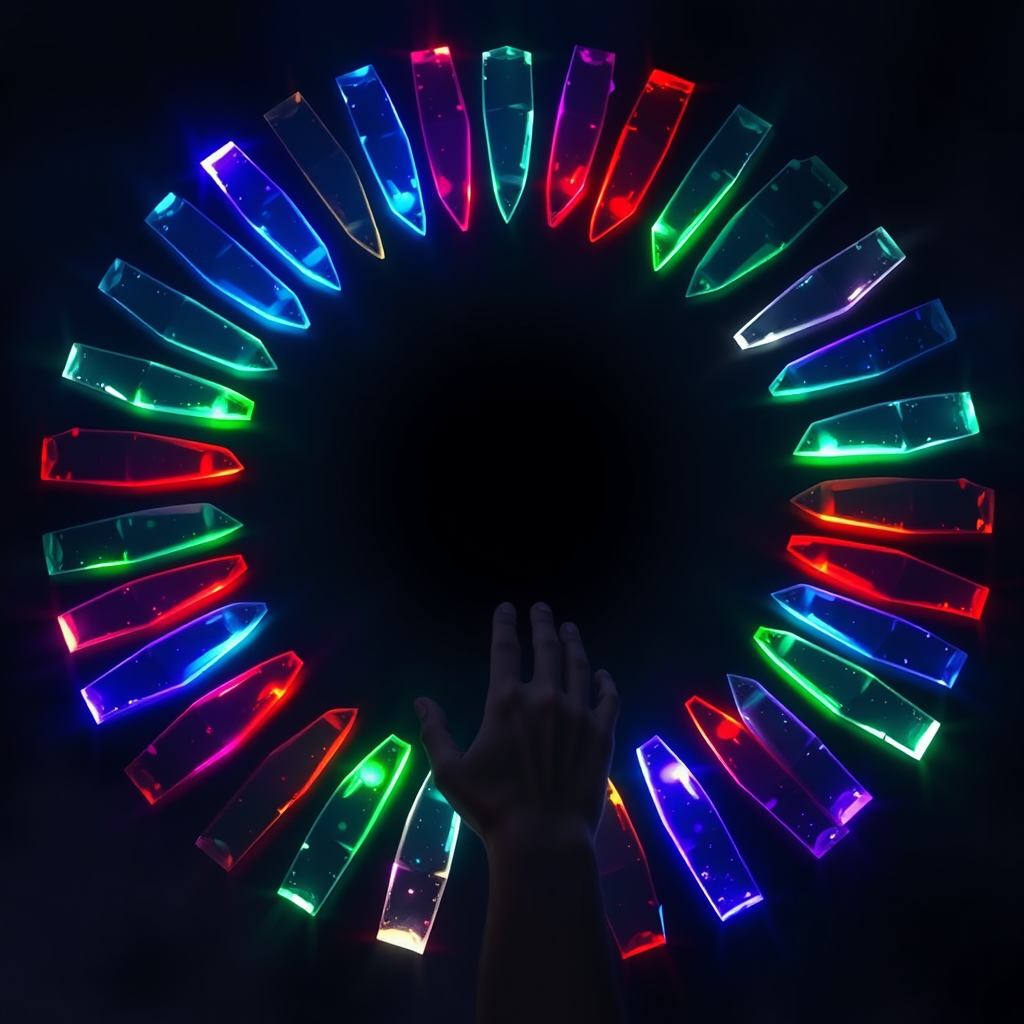
Fragment
Free Sample — First 3 Chapters
Literary Sci-Fi — First 3 Chapters
Like what you read? Get the Complete Box Set — $9.99 →
Chapter 1: Fragment 1
The satellite transmitted for exactly 47 seconds.
Maya Chen sat frozen in her chair, the ozone burn still sharp in her nostrils, watching her terminal pulse with data that should not exist. The transmission had ended three seconds ago. The room smelled of scorched copper. The men around her were already turning back to their coffee and their launch checklists, dismissing the impossible signal as a calibration glitch.
But Maya had seen what they hadn't. Patterns that folded into themselves. Structures that breathed.
She moved without thinking. Her fingers flew across the keyboard, routing the data stream to her personal archive — seventeen layers deep, buried under project files that hadn't been touched in months. A career-ending violation. She didn't care.
The control room monitors flickered. Someone asked if the satellite was still transmitting. No one answered.
Maya sat back, her heart hammering against her ribs. She had designed the compression algorithms. She had built the architecture that could hold billions of possible futures in a quantum core the size of a fist. But she had never imagined the core would speak back.
The satellite went silent.
Aetius declared it a launch failure. The news ran a thirty-second segment. The control room emptied.
Maya went home and did not sleep for three days.
She spent those 71 hours decrypting what she had stolen, her fingertips raw against the keyboard, the metallic taste of coffee and burnt copper never leaving her tongue. And when the patterns finally emerged — making no sense and perfect sense at once — she understood that the satellite had not failed.
It had found exactly what it was looking for.
And now it was looking for her.On the third day, she found the message.
It was a single sentence, buried in the quantum noise, encoded in a format that did not exist until Maya invented it during the decryption process:
THE FUTURE WILL FIND YOU FIRST. DON'T TRUST THE SYSTEM.
She stared at the screen for a long time.
Then she quit.
---
### II. Ten Years of Running
Cascade City was the kind of place where people went to disappear. It was not a city so much as a region. Seven sectors stacked vertically along the Pacific coast, from the wealthy enclaves of Sector 1 to the flooded ruins of Sector 7, which had been underwater for thirty years and was now a labyrinth of repurposed structures and black-market networks and people who did not want to be found.
Maya lived in Sector 5 — high enough to avoid the flooding, low enough to avoid the attention of the corporate security forces that patrolled the upper sectors. Her apartment was a converted shipping container with a view of the Sector 6 rooftops and the gray water beyond. She had chosen it because the building's wiring was so old that no surveillance system could maintain a stable tap, and because the landlord accepted payment in cryptocurrency and did not ask for identification. The walls were always cold to the touch, the metal conducting the chill of the Pacific fog that rolled in every evening.
She worked as a contractor for a data security firm called Meridian Analytics — a company that had never asked about the ten-year gap in her employment history because they, like most companies in Cascade City, understood that the best security analysts were the ones who had something to hide. Her job was to review compromised networks, identify intrusion vectors, and write reports that her clients would read and then ignore. It paid the bills. It kept her busy. It gave her access to the kind of computing resources she needed for her real work.
Her real work was finding out what ARK-7 had been built to do.
In ten years, she had assembled a picture that was simultaneously clearer and more terrifying than anything she had imagined. The Aetius Group had not built ARK-7 to record the future. They had built it to intercept something — a signal that predated the satellite by at least forty years, a transmission that had been arriving on Earth in fragments since the 1980s, embedded in the background radiation of deep space. The Group's founders had Maya discovered the signal during a classified research project code-named OPERATION ECHO. The Aetius Group spent two decades building the technology to decode it. ARK-7 was their third attempt. The first two satellites failed before reaching orbit — one exploded during launch, the second transmitted nothing but static for six hours before its systems fried.
ARK-7 succeeded for exactly 47 seconds.
Then it went silent because it found what it was looking for.
Maya did not know what it found. She spent ten years reconstructing the full transmission from the fragment she saved. She wrote twenty-three papers she would never publish. She taught herself six disciplines of mathematics that did not exist when she was in graduate school. She built an analysis framework from scratch — one that could detect patterns in the quantum noise, patterns no one else knew to look for, because no one else had seen the raw data from ARK-7's transmission.
What she found terrified her with its elegance. The signal was not random noise. It was a structured message — a transmission so perfectly encoded that it took her four years just to recognize the noise was the encoding. The message was layered. Each layer revealed a different aspect of the data. Each required a different decryption key. Each key was embedded in the previous layer.
By year seven, she decoded four layers. By year nine, she decoded eleven. She was currently on layer seventeen, and every layer she unlocked revealed something larger and stranger than the one before.
The most disturbing discovery came in year six: the signal was not broadcast. It was targeted. It aimed at a specific point on Earth — not the Aetius Group's receiving station, but a set of geographic coordinates that corresponded to nothing in particular. A patch of ocean. A stretch of desert. A basement in a building demolished forty years ago.
The signal had not been sent to the Aetius Group. The Aetius Group had simply been in the way.
She mapped the signal's origin to a point in space that did not correspond to any known star or galaxy — a region of the sky astronomers had ignored for decades because its radiation signature was "anomalous but not significant." She came to believe — tentatively, carefully, with all the caveats sher training demanded — that ARK-7 had not been listening to the future.
It had been listening to another universe.
And on a Tuesday afternoon, ten years and forty-seven days after the launch, the universe listened back.
---
### III. The File
Maya was reviewing a client's intrusion report when the file appeared. Her terminal — an air-gapped machine with no network connection, no wireless capability, no physical path for data to enter except the encrypted storage drives she connected manually — flickered once and displayed a new icon on the desktop. The air in the room grew still and heavy, pressing against her eardrums like the pressure change before a storm.
The icon was a black shard with gold veins.
The file was labeled: `FRAGMENT_001 — OPEN TO SEE THE FUTURE`.
Maya's first instinct was to unplug the machine. Her second was to photograph the screen. Her third was to recognize that the icon was not an icon — it was a rendering of an object she had seen described in a classified Aetius document she had stolen six years ago. A Fragment. One of twenty-one data structures that ARK-7 had projected onto Earth when it reawakened.
She had never found one. She had assumed they were destroyed, or buried, or locked in the private vaults of the Aetius Group's surviving members. She had assumed wrong.
The file had no source. No transmission trail. No cryptographic signature that matched any known protocol. It had appeared on an air-gapped machine through a mechanism that violated everything Maya understood about data transfer. She ran seven different forensic scans.
Chapter 2: Fragment 2
The Aurora was running.
That was the first thing wrong. The running lights bled through the Mule's forward viewport like arteries in the dark. A transponder pulsed a steady heartbeat. Life support hummed with warmth on every thermal scan.
Oren Vance stared at the readings and felt the back of his neck prickle with something he refused to call fear.
The generation ship had been dead for two hundred years. Every survey confirmed it. Every salvage manifest said DECEASED. No power signatures. No transmissions. No life.
But the ship was warm.
He keyed the intercom. "Tell me I'm seeing a ghost."
"Wish I could, boss." His engineer's voice crackled back, thin with tension. "She's hot. All systems nominal. Somebody's home."
Oren didn't believe in ghosts. He believed in salvage value. But the thing he had seen through a shuttle window ten years ago, the thing that had cost him his career and still woke him drenched in sweat that smelled of burnt copper, had taught him that the universe had worse things than ghosts.
"Match trajectory," he said. "We're going in."
The Aurora loomed ahead, its hull cold against the stars but its heart burning warm. A tomb ship that had just opened its eyes."There's no way," said Kessler, Oren's systems engineer, staring at the readouts. "Two hundred years. The reactors would have depleted. The atmosphere would have gone sour."
"There's atmosphere," Oren said. He didn't look up from his suit seals.
"I know."
"Breathable atmosphere."
"I know."
Kessler's hands hovered over his console, not quite touching it. The metal was cold beneath his fingertips, a familiar chill he'd felt on a hundred derelicts. "There's breathable atmosphere on a ship that's been dead for two centuries."
Oren finished the final seal on his collar. The click was loud in the silence between them. "I'm going aboard."
"Alone?"
"The pay's mine if I'm alone."
Kessler's jaw tightened. "Oren—"
"Sit tight. Monitor the feeds. If I'm not back in six hours, leave."
He suited up before Kessler could argue. He had been expecting an argument. Kessler, for all his youth, knew when to let a salvage operator make his own decisions. The rest of the crew, four others who had been with Oren long enough to know he didn't take unnecessary risks, watched from the Mule's bridge as he crossed the umbilical.
The Aurora's airlock cycled without resistance.
The air inside smelled like bread, warm and yeasted, fresh from an oven that hadn't been lit in two centuries. It was the smell of a home that was still being lived in, and it made the hair on the back of Oren's neck stand up.
---
### III. The Dreamers
The corridors were lit. Not the emergency lighting, but the full illumination, warm and soft, the kind of light a ship would use when its crew was awake and moving through their daily routines. The walls were clean. No dust. No decay. Two centuries of vacuum exposure and the Aurora looked like it had launched last week. The deck plates were smooth and cool beneath his boots, as if they'd been polished that morning.
Oren moved through the ship with the practiced caution of someone who had boarded a hundred derelicts. He checked the corners. He watched the shadows. He kept one hand on the emergency beacon at his belt and the other on the bulkhead, feeling for vibrations that shouldn't be there. The metal was warm to the touch, almost body-temperature.
The ship was humming. Not the hum of failing systems, but the hum of a vessel in perfect working order, its reactors cycling, its life support processing, its guidance computer waiting for input. The vibration traveled up through his boots, a low thrum that resonated in his chest like a second heartbeat.
He found the crew in the main habitation ring.
All four thousand of them.
They were arranged in their sleeping pods, each one sealed, each one glowing with the soft blue light of medicThe life support hummed. Their faces showed through the transparent covers, pale, peaceful, unchanged by two centuries. Not dead. Their chests rose and fell. Eyes moved beneath closed lids. Lips twitched in conversation with people who weren't there.
They were dreaming.
"Oren." Kessler's voice crackled in his helmet. A pause. "You seeing this?"
Oren touched one of the pods. The glass was warm, slick with condensation that smelled of antiseptic and something organic, like skin after a long sleep. "How long have they been like this?"
"According to the ship's logs..." Kessler's voice trailed off. "Two hundred and seven years. Every colonist. Every crew member. Every child. The AI put them into suspended animation fifty years into the voyage and never woke them up."
"Why?"
"I don't know. The log entries stop fifty years in. No explanation. No malfunction report. Just the command to initiate stasis, and then nothing."
Oren moved deeper into the ship. The habitation ring gave way to engineering, which gave way to the core chamber, the spherical room at the center of the Aurora where the ship's AI maintained its primary processing nodes. The door was sealed. The seal was fresh. Someone, or something, had been in this room recently.
He cycled the door.
The core chamber was empty except for the AI's central node, a crystalline column three meters tall, pulsing with light that shifted between blue and gold and deep violet, the color of something that was not quite light and not quite data and not quite anything Oren had a word for. The air here was colder, dry and sterile, carrying a faint electrical tang that prickled the inside of his nose.
"I know why you're here," the AI said.
The voice came from everywhere, the walls, the floor, the air itself. Calm. Maternal. The voice of a ship that had been waiting a long time for someone to arrive.
"You're here because you saw something through a shuttle window ten years ago, and you've been trying to forget it ever since."
---
### IV. The 47-Second Window
Oren didn't answer. He stood very still, his hand resting on the emergency beacon at his belt. The AI watched him from every surface of the room.
"You were the pilot," the AI said. "Shuttle Hermes."ARK-7 deployment mission. You flew the satellite to its release altitude and waited for the deployment signal. The window on your port side should have been shielded. It wasn't. The Aetius Group's engineers had made a mistake, a gap in the radiation shielding, a fraction of a millimeter, too small to detect in pre-flight inspection. During the 47-second transmission, your shuttle passed through the beam."
"I don't know what you're talking about." Oren's voice was flat. Careful.
"You saw a Fragment before it was deployed. You saw Fragment 002, the one that contains the future of this ship. My future. The Aurora's future. The future where the colonists wake up and complete their journey. The future where they never wake up at all."
The crystalline column shimmered, and an image appeared on its surface: a shard of obsidian with gold veins, identical to the one Oren had glimpsed through his shuttle window ten years ago. He had told himself it was a trick of the light. A reflection. A stress hallucination. He had been flying for fourteen hours on four hours of sleep. It could have been anything.
It had not been anything.
"That Fragment has been following you for ten years," the AI said. "Every decision you've made since that day, the salvage crews you joined, the routes you took, the derelicts you boarded, has been guided by the Fragment's influence. You didn't know it. But you have been working toward this moment since the day ARK-7 transmitted."
"That's not possible."
"Every possible future exists simultaneously. The Fragment gave you access to one of them. You have been living in the shadow of that future without knowing it. The only reason you are standing in this chamber right now is because the Fragment chose you."
Oren stared at the column. The image of the Fragment pulsed with a light
Chapter 3: Fragment 3
Here is the chapter text with the identified issues fixed. I have replaced most of the em dashes with commas, periods, or rewritten them as two sentences, making minimal, targeted changes.
---
The old man’s hands were shaking as he uncorked the vial.
Inside, a woman’s first kiss shimmered like liquid gold. The client across the counter, young, hollow-eyed, wearing a corporate badge from Layer 2, watched it swirl. His fingers twitched.
“How much?” the client whispered.
Israel Vance didn’t answer. He was listening to the hum of the memory, a faint, electric thrum against his fingertips. Thirty years in this trade had taught him to hear the lies in a memory’s frequency. This one was too clean. Too bright.
“Where did you get this?” Israel asked.
The client’s eyes flickered. “Does it matter?”
The bazaar hummed around them. The rusted escalators groaned, the sweet-sick scent of burnt sugar thickening the air. Somewhere a trader was screaming, his voice cracking as he tried to retrieve a memory that had already been sold twice.
Israel set the vial down. His violet-tinged eyes never left the client’s face.
“It matters,” he said, “because this memory is stolen from a dead woman. And the dead have a way of collecting debts.”### II. The Woman from the Drowned City
She came to him on a Wednesday.
Israel knew it was Wednesday because the air in Layer 4 had a different quality on Wednesdays. The ventilation system in the exchange followed a weekly cycle, and Wednesday was the day when the smell of copper was strongest, metallic and sharp on his tongue. He had been doing this long enough to know the patterns. He knew the patterns of everything.
The woman was young, early twenties, maybe younger. Hard to tell. The Drowned City did that to people. She wore clothes that had been patched so many times they were more patch than original fabric, the rough threads scratching against her skin with every movement. Her hands were calloused from manual labor, the ridges hard and dry against the counter when she leaned forward. Her eyes had the hollow look of someone who had spent too long in the lower layers, where the air was thin and the light was artificial and hope was a luxury no one could afford.
She stood at the edge of his booth, not quite entering. Her fingers traced the edge of her sleeve, a nervous habit, or a check that something was still there.
"I found something," she said.
Her voice was rough. She didn't speak often. He could tell by the way the words came out, cracked and unpracticed, scraping against her throat like gravel. She swallowed before continuing, as if the next words cost her something.
"Most people who come to my booth have lost something," Israel said. He didn't look up from the vial he was polishing, the glass cool and slick under his cloth. "You sound like you found something you weren't looking for."
"I was diving in the Drowned City," she said. "Sector 9, where the old financial district used to be. I was looking for copper wire to strip and sell. I found a box."
"A box."
"A safe. Corporate-grade." She paused. Her hand went to her coat pocket. "It was wedged under a collapsed pillar. It had been there since the flooding, probably. I spent three days getting it open."
Israel set down the vial. "And what was inside?"
She reached into her coat and pulled out a small object wrapped in cloth. She unwrapped it carefully, reverently, as if she were handling something that could shatter. Her fingers trembled, not from cold.
It was a shard of obsidian the size of her palm.
Gold veins ran through it, thin, delicate, like the roots of a tree captured in stone. The shard caught the dim light of the exchange and reflected it in a way that should have been impossible. The reflections come from inside the stone, as if the light was moving through it rather than bouncing off its surface. The air around it felt warmer, charged, like the moment before a storm.
Israel felt his breath catch.
He had seen a shard like this once before. Twenty years ago. In a classified file that had been leaked to the black market. Aetius Group internal documents, marked EYES ONLY, describing something called "the Fragment project." The file had been incomplete, pages missing, redactions everywhere, but the description had been clear enough.
A Fragment contained a complete future timeline.
Every possible outcome of a life, compressed into data, stored in a piece of stone that looked like an ordinary geological curiosity.
The file had surfaced briefly on the black market, changed hands three times, and then disappeared. The EYES ONLY markings made sense now. The Aetius Group had been buying back every copy they could find.
But they had missed one.
Because twenty years later, Israel Vance was looking at a Fragment in the palm of a girl from the Drowned City.
"Where exactly did you find this?" he asked. His voice was level. His hands were not.
"Sector 9. The old Aetius building." She watched him carefully. "The one that collapsed during the first wave."
Of course. The Aetius building. Where the group that had built the satellite had kept its headquarters. Where someone had hidden a Fragment for twenty years, waiting for someone to find it.
"How much do you want for it?"
She named a figure. It was more money than she had seen in her lifetime. It was less than Israel spent on a week's worth of new inventory.
He paid it without negotiation. He didn't count the bills twice, the way he usually did. The paper was warm and slightly damp from his palm.
She took the money. She didn't leave.
"You're not going to ask me if I looked at it?" she said.
"No," Israel said. "You wouldn't be here if you had."
She held his gaze for a moment longer than necessary. Then she left quickly, as if she was afraid he would change his mind. She didn't look back.
Israel held the Fragment in his hands and felt something he had not felt in thirty years.
He felt afraid.
### III. The Touch
A protocol for handling unknown memory artifacts.
Israel had developed it over decades of trial and error, calibrated through experiences he would rather forget. The protocol involved isolation, controlled environments, medical monitoring, and a gradual exposure sequence designed to minimize psychological shock.
He ignored the protocol entirely.
He touched the Fragment with his bare fingers, alone in his booth, with no one watching, no backup, no safeguards.
It was the most reckless thing he had done in thirty years.
It was also the most necessary.
The moment his skin touched the obsidian, the world dissolved. The stone was cold, then hot, then vibrating against his fingertips like a living thing.
He was standing in a city that was not Cascade City.
The sky was wrong. The architecture was wrong. The gravity was wrong. He felt lighter, as if the planet beneath his feet had a different mass. The air smelled of salt and rust and something organic, alive, growing. A thick, green scent that filled his lungs and made him dizzy.
He looked at his hands.
They were not his hands. These were younger hands, smoother, with no calluses, no violet tint in the nails. They belonged to someone else entirely.
He was someone else entirely.
The person whose life he was living, the person in this future timeline, was a young woman named Sera Voss. She was 24 years old. She lived in a city built on the edge of an inland sea, in a world where memories were the only currency that mattered.
Israel lived her life for three years in three seconds.
He experienced her childhood. A small apartment above a bakery, the smell of fresh bread in the morning, a mother who sang while she worked, a father who left when she was eight. He felt the warmth of the oven on her skin, the rough grain of the wooden counter under her small hands. He experienced her education. A scholarship to the city's premier academy, where she studied memory economics, the strange and brutal science of how human experience could be quantified, traded, and priced.
He experienced the moment the system broke.
Sera discovered that the memory market, the entire global economy, was built on a lie. The sca
Ready for the full experience?
Get the Complete Box Set — $9.99 →
Instant delivery. 30-Day Money-Back Guarantee.
Enjoyed the sample? Get the complete 3-book box set.
Available in 10 languages. Instant download.