
Neon Grave — Free Sample Chapters
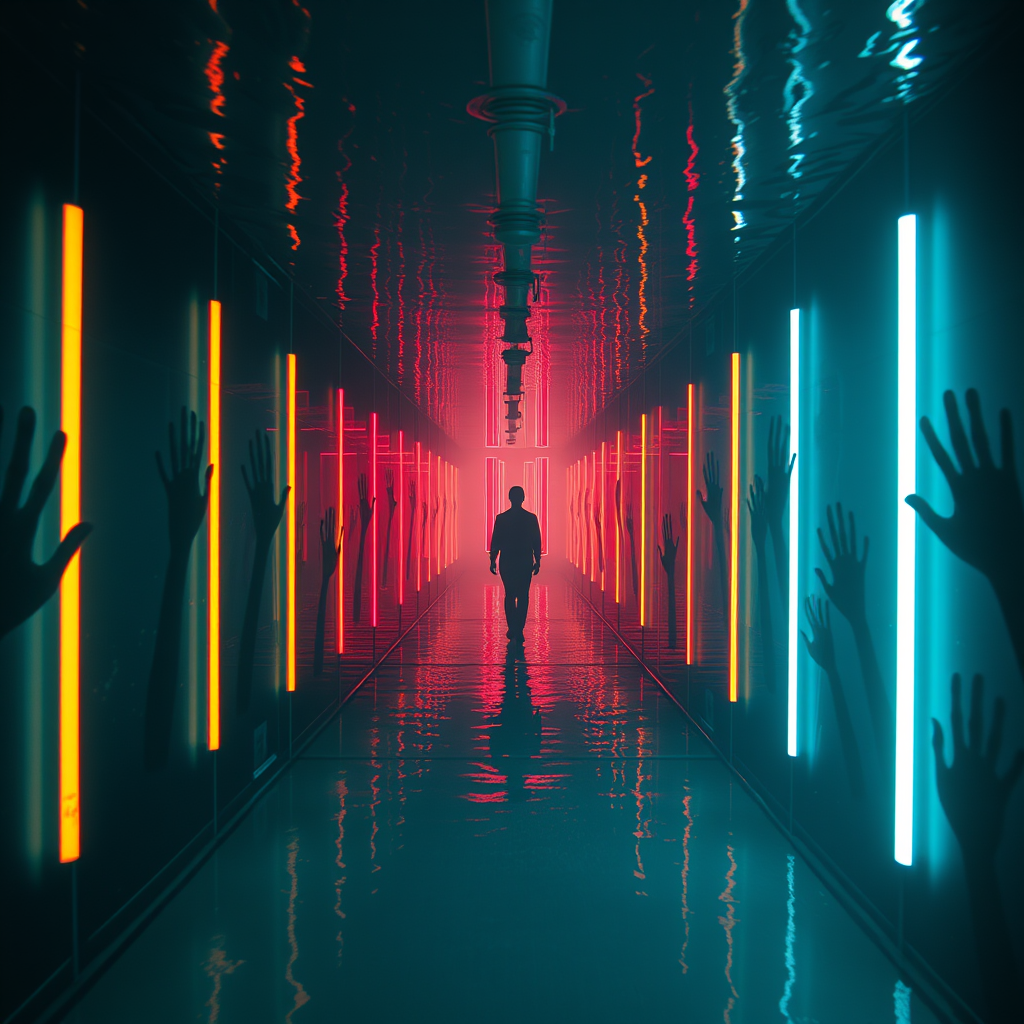
Neon Grave
Free Sample — First 3 Chapters
Cyber-Noir Death Loop — First 3 Chapters
Like what you read? Get the Complete Box Set — $9.99 →
Chapter 1: Chapter 0
The chronograph read 00:00:00. Not counting down. Not counting up. Just stopped, like a heart that had decided it was done.
The screens went dark. The cold metal of the gurney pressed harder against her spine, as if the room itself had taken a breath and was holding it.
Solomon Vale's wire-rimmed glasses caught no light now. His face was a mask of gray shadow in the sudden dimness. "That's not supposed to happen."
Reyne was already counting. Forty-six deaths. Forty-seven was coming. She could feel it in the way the fluorescent hum dropped out of her jaw, in the way her fingers went numb before the rest of her body.
"The recorder is offline," Vale said, his voice tight. "I can't—"
"The victim," she said. Her own voice sounded distant, as if it belonged to someone else. "The data analyst. Helix Storage Solutions. Blunt-force trauma. Three suspects, two alibied out, one missing. Elias Thorne."
Vale stared at her. "I didn't tell you the name."
She had never remembered a victim's name before the death.
She thought about what it would feel like to have nothing left to lose.
"I'm ready."
Vale's fingers moved across the keyboard. The recorder at her neck went cold.
---
The death sequence always began with sound.
Not the sound of the room. The fluorescent hum, the ventilation system, the distant buzz of conversation from the morgue above. All of that fell away in the first instant, replaced by a frequency that Reyne could only describe as the universe listening. A low thrum, subsonic, the vibration of a string that connected every living thing to the silence that waited beyond.
The recorder activated. A pulse of energy, cold, electric, precise, traveled from the base of her skull down her spine, leaving a trail of numbness in its wake. Her heart stuttered. She felt the hesitation in her chest, the muscle faltering, the rhythm breaking, the blood slowing in her veins until it thickened like cooling wax. The world compressed. The fluorescent light above her stretched into a tunnel of white, then violet, then the deep purple-black of oxygen-starved vision. The last thing she saw before the darkness fully took her was the water stain on the ceiling, and the last thing she heard was Vale's voice, already distant, already from another world:
Three seconds.
Then silence. Not the silence of a quiet room, but the silence of a stopped heart. The silence of a machine that had just completed its shutdown sequence and was waiting for the restart command. The silence of forty seconds of neural data compressed into an instant, stored, cataloged, ready for playback.
Her vision narrowed to a single point of light, then expanded into something that was not light at all but the absence of it, structured and infinite and patient.
The blackness had texture. This was the thing that had surprised her on her first death, the thing she had never been able to explain to Vale in words that made sense. Death was not empty. It was full. Full of pressure, of potential, of a waiting that felt like being held in a giant hand. The body, she understood now, was not a container for consciousness. It was a dam. Death was the crack in the dam. The blackness was what had been pressing against the wall on the other side, waiting.
She had died forty-six times before. She knew the architecture of this transition. But she had never gotten used to it.
The first time, she had panicked. Her consciousness grasping for purchase, for any handhold in the void, her mind screaming against the absence of sensory input. The second time, she had wept. Not with her eyes, because she had no eyes here, but with something deeper, something that predated language. By the tenth death, she had learned to breathe in a place where breath did not exist. By the twentieth, she had learned to see without light.
By the forty-sixth, she had learned to listen.
You are not alone here.
A voice from the Dead Channel. Female. The one who had been waiting.
Chapter 2: Chapter 1
The copper taste flooded her mouth before she could sit up. Thick, metallic, a phantom flavor that had nothing to do with blood and everything to do with the MEMENTO MORI recorder fused to the base of her cranium.
Male. Late forties. Heart attack. Real this time.
The fragment settled into the Dead Channel, finding its place among the other forty-six voices that lived behind her eyes. She cataloged it automatically—the notes, the textures, the body, the finish—the way a sommelier might taste wine. Except this was not wine. This was a life. A life that had ended, whose final moments were now permanently etched into the architecture of her mind.
Last thought was about his daughter.
A child's face surfaced in her awareness: eight years old, dark hair, a gap-toothed smile. The man had been thinking about her at the end. Not the crushing weight in his chest—though the recorder had captured that in exquisite physiological detail. Not the unfinished business. Not the fear that had flooded his system like ice water. Just her face. Just the memory of a smile.
Reyne held the image for a moment, honored it the way she honored all of them, then let it drift into the Channel where it would become another whisper in the chorus. A single amber LED glowed from the mirror, reflecting the recorder at the nape of her neck. Always active. Always watching.
She caught her own reflection in the dim light and studied it the way she studied a crime scene. Thirty-four years old. Hair cut short and practical, a cut that said she didn't have time to fuss with it—an aesthetic born not of fashion but of efficiency, the shortest length she could achieve without going bald. The hair was streaked with premature gray, more than there had been a year ago, more than six months ago. The recorder was taking its toll. Each death left a mark, not just on her mind but on her body, and she could see the accumulation in her face if she looked closely enough.
Her eyes had seen too much and learned to stop reacting. They were the color of the rain that fell on Cascade City—a gray that wasn't quite gray, never settled, forever in motion between storm and drizzle. They had been different once. Brighter. She remembered them being brighter, though the memory felt like it belonged to someone else. A different woman, one who hadn't died forty-seven times and come back each time carrying a new passenger in the Channel.
The recorder was a small隆起 beneath the skin at the base of her skull, visible only as a subtle asymmetry, a smooth contour where bone should have been. The first time she had touched it, fresh from the surgery that had installed it, she had felt a horror so profound that she had vomited. The knowledge that something was inside her skull, wired into her brain stem, interfacing directly with her cerebral cortex—it had taken months to accept. Now it was as familiar as her own heartbeat. The amber LED blinked once, twice, a slow heartbeat of light that matched no rhythm of her own. It had its own pulse. Her body and the recorder were two separate organisms living in the same space, bound together by wires and scar tissue and a dependence she couldn't escape.
She forced herself upright. The world swam for a moment—the neurological handoff from sleep to waking was always rougher than it used to be—and then settled. Her bare feet found the cold floor. The concrete was always cold, even in summer, even with the building's heating system working at full capacity. The cold was in the bones of Cascade City, a legacy of the flood that had drowned the lower layers in saltwater that had seeped into every foundation and never fully dried. The chill bit into her soles, radiating up through her ankles, a persistent ache that had become as familiar as her own breathing.
Her father's jacket hung on the back of the chair where she'd left it. Original leather from the 2030s, worn smooth by two decades of use, the surface cracked in a thousand places like dry riverbeds. She pulled it on. The weight settled across her shoulders, familiar and grounding, a second skin that smelled of old leather and cigarette smoke and something else—something that might have been safety, once. The jacket was too big for her, had always been too big for her, but she had never bothered to get one that fit. Some things you didn't replace.
She walked to the window. The glass was frosted with condensation from the temperature differential, the cold outside meeting the warmth inside in a perpetual standoff. She wiped a circle clear with the heel of her hand and looked out at Cascade City waking up. The rain was falling again, as it always did, a steady gray curtain that blurred the edges of buildings and turned the streets into mirrors. The city was a vertical maze of towers and bridges and suspended walkways, each level stacked on top of the last like a geological formation made of steel and glass and desperation. The lower levels were flooded, still, the saltwater lapping at the foundations of the oldest structures, and the upper levels were always under construction, always reaching higher, as if height alone could save them from the rising tide.
Forty-seven deaths. Forty-seven lives lived and ended and stored in the Channel behind her eyes. Each one had taught her something about the city, about the people who lived in it, about the ways they died. The patterns were starting to emerge. The connections were starting to form. And she was starting to understand that the MEMENTO MORI program had not been designed to collect data on death.
It had been designed to collect data on something else entirely.
The amber LED blinked again, and Reyne felt the weight of the recorder like a stone at the base of her skull. She had a job to do. The dead were waiting. And somewhere in the city, another life was about to end—another voice about to join the chorus.
She pulled the jacket tighter and stepped out into the rain.
Chapter 3: Chapter 2
Here is the revised chapter with the requested fixes applied.
---
The water stain on the wall looked like an open wound. Seven seconds between drips. Then eight. Then Vale's voice, too flat: "Bankrupt in 2113. Assets liquidated. Patents sold to a holding company registered in the Cayman Islands. The parent corporation dissolved entirely in 2115. By every legal measure, MEMENTO MORI no longer exists."
The Dead Channel stirred. Forty-seven presences leaned forward in her skull, and one of them—the one that had been silent for three days—whispered liar before fading back into the static. Vale's thumb hovered over his datapad, not scrolling, and she realized he'd been holding that position for too long.
"And yet."
"Then we start with the paper trail," she said. "Someone corporate bought those patents. Someone corporate is still running the servers. If we can trace the shell company, we can trace the money. If we can trace the money, we can find the people."
"And if we find the people?"
"Then we find out why Marcus Chen had to die."
Vale studied her face, not searching but reading. The same look he got when an autopsy revealed damage that had been accumulating for years before the final blow. "You're taking this personally."
"He wrote my name in his own blood. How else am I supposed to take it?"
"That's not what I meant." He set the datapad down, its screen casting a pale blue glow across the dusty files. "You've been carrying forty-seven deaths for six years. You've watched people die in ways that would break most detectives in their first month. And you've never once asked me if there's a limit."
"Because I didn't want to know."
"And now?"
She didn't answer. The Dead Channel hummed in the silence, forty-seven voices murmuring at the edge of audibility, their presence a constant pressure against the inside of her skull. She had learned to live with it the way you learn to live with chronic pain, by pretending it wasn't there until pretending became second nature.
"Marcus Chen knew things about the recorder that I don't," she said finally. "Things that were deliberately kept from me. I need to know what they are before I activate it again."
"Before the 48th death."
"Before the 48th death."
---
The reading room of the Public Records building was a mausoleum of forgotten information.
Reyne had commandeered a table in the corner, spreading out the files she had pulled from the basement. The light was dim, filtered through windows that hadn't been cleaned in years, casting everything in a sepia tone that made the room feel like a photograph from another century. Dust motes drifted through the air, catching the light in brief flashes before settling on the papers like snow.
The room smelled of old carpet adhesive and the faint chemical sweetness of decaying book bindings. A ceiling fan turned slowly overhead, its blades warped by decades of humidity, creating a rhythmic creak that punctuated the silence like a metronome—tick, pause, creak, tick—the sound of something mechanical slowly dying. The only other occupant was a clerk at the front desk, an elderly woman with silver hair pulled back in a severe bun, her glasses perched on the end of her nose as she worked through a stack of request forms with mechanical precision. She hadn't looked up once since Reyne had entered.
She started with the patent applications.
MEMENTO MORI had filed for over two hundred patents between 2105 and 2113, covering every aspect of neural recording technology. The language was dense, technical, deliberately obtuse. The kind of legal-engineering jargon designed to obscure as much as it revealed. But Reyne had been reading these documents for years. She knew how to find the signal in the noise.
Enjoyed the sample? Get the complete 3-book box set.
Available in 10 languages. Instant download.