
The Stolen Stream — Free Sample Chapters
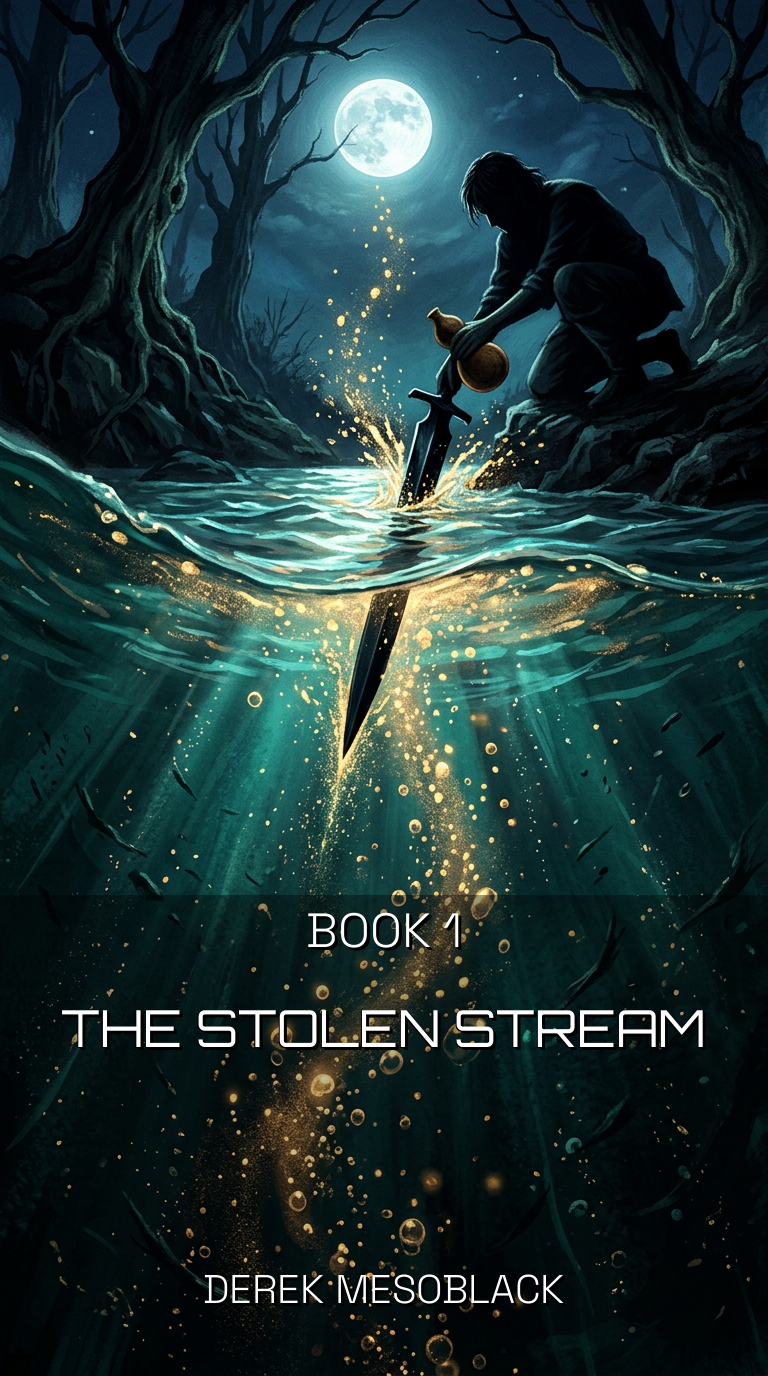
The Stolen Stream
Free Sample — First 3 Chapters
Hard Sci-Fi Space Opera — First 3 Chapters
Like what you read? Get the Complete Box Set — $9.99 →
Chapter 1: Chapter 01 The Second Hand
The vibration never stopped. It lived in the bones now, a low 23-hertz hum that made the molars ache and left the tongue tasting of copper and dissolution. Kai pressed his palm flat against the mirror, watching the young face stare back—smooth skin, clean nails, hands that had never known the stiffness of age. The reflection was a lie. Behind the eyes, something ancient shifted, something that made servants hesitate and businessmen look away. One hundred fifteen years of biology. Four hundred thirty-seven years of transit. The gap between them had calcified into a presence he carried like a second skeleton.
He could still taste the last jump. The Frozen Light Singularity had pulsed through the estate's crystalline veins, and he'd stepped from the Spire's 28th floor—circa 2247, air thick with recycled nitrogen and the sharp tang of ozone—into the Vienna manor's main hall. 1888. Coal smoke. Horse manure. A winter that had already happened and would never warm again. The transition had been smooth, as always. The body learned to forget the grinding, the way it learned to forget any constant torment. But the weight remained. Not wisdom—wisdom implied understanding earned through experience. What Kai carried was the accumulated gravity of centuries not lived but passed through, each jump extracting its 10:1 Toll like a tax collector who never missed a payment.
His father called it perspective. A fair price for seeing time as others saw geography. But standing here now, watching his own young face betray the age that lived behind it, Kai wondered if the debt was ever paid. The reflection offered no answer. Only the hum. Always the hum. Gravity's pull as the Arrays adjusted his location in spacetime. He had crossed temporal boundaries more times than he had crossed rooms.
He'd never added up the total. The Toll was just subtraction. Small payments extracted over a lifetime, the way a tax is extracted from every transaction. You didn't notice them because you didn't want to notice them. The body was a ledger, and ledgers were best kept by people who didn't have to look at them.
But the body kept its own ledger. And ledgers, given enough time, always come due.
---
The glitch happened on a Tuesday.
Kai was in the family's private transit chamber, a circular room lined with Dilation Arrays, their crystalline matrices glowing with the deep violet light of trapped stellar collapse. The light was not steady. It pulsed, slowly, at a rhythm that matched nothing in the natural world, the heartbeat of a star that had been compressed to the size of a fist and suspended in a state that physics had no name for. The chamber was one of seventeen in the Vienna estate, this one reserved for family use, its walls paneled in wood that had been harvested in 1788 and maintained in temporal stasis ever since. The wood still smelled of the Black Forest, the particular scent of pine and resin and earth, preserved across centuries by the same technology that kept the family's assets frozen in their most profitable state. The smell had not changed in 238 years. It would not change in another 238, unless someone turned off the stasis field and let time finally catch up.
The temperature in the chamber was constant, 16 degrees Celsius, cold enough that the breath steamed slightly, cold enough that the skin tightened and the hairs on his arms rose, cold enough that the air felt sharp and thin in the lungs, each inhalation a small shock of clarity. The cold was deliberate. The Arrays operated more efficiently at lower temperatures, and the family had never been interested in comfort when efficiency was at stake. The floor was polished stone, black slate, quarried in a century that predated the family's temporal operations, its surface worn smooth by 400 years of footsteps, slick and cold against the soles of his shoes, the chill seeping through the leather and into the bones of his feet. The walls hummed. The floor vibrated. The air carried the tang of ozone and cold metal, the smell of a machine that had been running longer than most nations had existed.
Kai was preparing for a routine jump, a 200-year forward leap to attend a Consortium board meeting in 2188. The Toll would be twenty years. A significant payment, but not unusual. His father, Julian, made 300-year jumps without visible concern. The family's actuaries calculated the cost against projected returns and filed it under "acceptable attrition." The phrase was written into the quarterly reports, the annual reviews, the strategic projections. Acceptable attrition. As if biological degradation were a budget line item, something to be optimized, managed, depreciated over the lifespan of the asset.
Kai stepped into the aperture. The Synchronizer at his wrist, a delicate web of silver-doped quartz with an exotic matter core, his own design, built in secret over three years of stolen lab time, pulsed once, violet light bleeding through his sleeve. The device was small, barely larger than a pocket watch, but intricate beyond anything the family's engineers could have produced. The quartz filaments were woven so fine that they were visible only in certain light, their patterns spelling out a geometric language that Kai had invented himself. The exotic matter core was a fragment of something he'd found in the Restricted Archive, a sample that had been logged as "depleted" and discarded, but that he'd recognized as something else entirely. The family used Dilation Arrays for their jumps. Kai used the Synchronizer. He'd never told anyone. The device was heretical, it didn't fight the temporal stream like the Arrays did. It harmonized with it. Swam with the current instead of against it.
The Frozen Light Singularity pulsed. The aperture opened, a column of suspended stellar collapse, the light inside neither moving nor still, existing in a state that physics had no word for, a condition that the universe had not intended to exist. Kai felt the familiar dissolution, the body scattered across the differential, the self becoming a pattern of information distributed across a medium that didn't correspond to space or time, the Toll extracting its payment. Twenty years of biological aging, compressed into 1.4 seconds of transit. The cold spread from his fingertips first, the characteristic beginning of any jump, the sensation of the extremities losing their connection to the body's timeline, his fingers going numb as if plunged into ice water, then the ache spreading up his wrists like frostbite setting in from the inside. Then the core. Then the certainty that he was himself, and not something else, scattered across the gap between departure and arrival.
And then the glitch.
It was small. A 0.03% deviation in the frozen light calibration. The kind of anomaly that maintenance crews cleared a dozen times a day, a fluctuation in the containment field, a micro-variance in the exotic matter density, a data point that triggered a routine correction and was never reported to anyone who mattered. But the Synchronizer caught it. The Synchronizer caught everything. The Synchronizer had been built to notice what the Arrays had been trained to ignore.
Its display flickered, the violet light stuttering, recalibrating, compensating for a distortion the Dilation Arrays had learned to overlook. The quartz filaments glowed, not the steady violet of a properly calibrated jump, but an amber that Kai had never seen before, a warning color, a color that did not exist in any of the device's documented states. The exotic matter core warmed against his skin, not hot, not dangerous, but warm in a way it had never been before, as if it had woken up from a long sleep and was looking around for the first time, a gentle heat that spread up his forearm like a fever, a warmth that carried a faint electrical tingle, the sensation of a limb that had been asleep suddenly remembering it was alive.
Two numbers appeared on the readout.
Biological Age: 2
Chapter 2: Chapter 02 The Frozen Gardens
The number came first.
Kai Eschendorf was seventeen years old, standing in the 1954 kitchen of Aldric's Hold, watching his mother brown onions in butter, when the air in front of his face split open and a single digit hung there, burning gold.
3.
It lasted less than a heartbeat. Then it was gone, and the gas flame still hissed, and the onions still sizzled, and Selene was still stirring, oblivious.
Kai blinked. The afterimage of the number floated behind his eyelids, a ghost of light. He touched his cheek. The air was cool there, normal. Nothing had burned him. Nothing had happened.
But something had happened. He knew it the way he knew the grain of the oak floors under his shoes, the way he knew the particular hush of the east wing's gas lamps, the way he knew that his father's name was Aldric but that no one in the compound used it anymore. He knew it the way he knew that the west wing smelled of ozone and the east wing smelled of wax, and that neither smell had ever felt like a w"Kai." His mother's voice, soft, patient. "You're staring."
He looked at her. At the mint-green stove. At the black and white checkerboard tiles worn smooth by decades of footsteps. At everything he had known, rearranged.
"Sorry," he said. "Just thinking."
But he wasn't thinking. He was waiting. For the next number. For whatever came after.
The kitchen stayed still. The onions browned. The world did not end.
And Kai Eschendorf, heir to a compound that spanned six centuries, did not understand that something had already begun. He let his mother dismiss him and make dinner herself, her hands moving with the practiced confidence of someone who had learned to cook when cooking was necessary, not optional, the skin of her knuckles warm and slightly damp from the steam. She never explained why. She never needed to. The kitchen was her territory, the one room where the compound's temporal technology was absent, where the air smelled of onions and garlic instead of ozone and violet light.
The gardens were 1788: geometric hedges trimmed into precise shapes, frozen fountains that caught the moonlight in arcs of crystalline spray, water suspended mid-fall by temporal stasis. The stasis was supposed to be aesthetic. A choice. The water looked beautiful, frozen mid-arc, each droplet catching the light at the same angle it had caught when the stasis field activated. It also never moved. It had not moved since before Kai was born. The hedges had never grown a millimeter beyond their trimmed shapes, their leaves stiff and brittle, crumbling to powder under pressure. The fountains never completed their arc. The gardens were perfect. They were also dead, preserved in a moment that would never change, maintained by a system that valued stasis over life. As a child, Kai had tried to catch one of the frozen droplets, standing on tiptoe, reaching toward the arc of suspended water. His fingers passed through the stasis field — cold, weightless, the sensation of touching something that existed and did not exist at the same time, the water droplets dry against his skin, refusing to wet him, the air around them so still and cold it felt like pressing his face against glass. The droplet did not move. It did not yield to his touch. It was perfect and impossible to change.
He grew up in the compound. He learned to walk in corridors that shifted centuries beneath his feet, the floor changing from hardwood to marble to smart-glass without warning, the transition so smooth that he stopped noticing it by the time he could describe what he saw, though sometimes the temperature changed by a degree or two, a subtle shift in the air against his ankles. The servants moved through the house with the particular silence of people who learned that being noticed during a family argument was dangerous. They walked on the balls of their feet, their movements smooth and deliberate, their eyes fixed on the tasks in front of them, their footsteps barely audible even on the creakiest floorboards, the fabric of their uniforms rustling softly with each step. They aged faster than the family. Kai noticed that when he was old enough to compare — the cook who had been with the household since he was born, her hair grayer than it should have been.ave been, her hands more gnarled, her back more curved, the skin of her knuckles papery and thin, the veins beneath it standing out like blue threads. The family's explanation was genetic variance. Kai had accepted that explanation for as long as he could. The Dilation Arrays pulsed in the walls, the violet glow of the Frozen Light Singularity bleeding through the crystalline veins that carried temporal energy through every room. The drone was constant. Twenty-three hertz. Felt in the molars, a low vibration that resonated through the jawbone and into the skull, a sound that was never silence. Kai had been feeling it since before he had molars.
The heir's education was thorough and designed. Temporal physics at eight, the 10:1 Toll, the frame-dragging effect, the mathematics of frozen light. The lessons were conducted in a room that existed in 2188, the walls covered in displays that showed the equations in real time, the tutor a Consortium researcher who had been selected for their ability to explain complex concepts without asking uncomfortable questions, their voice flat and even, the words landing like stones in still water. The mathematics were elegant. The 10:1 Toll. It never mentioned the millions of years that had been extracted from donors who had never agreed to pay. It was a history written by the winners, and the winners had made very sure that the losers had no voice.
Ethics at twelve, a carefully curated curriculum that explained why the family's control of time was not merely profitable but necessary, a stabilizing force in a world that would otherwise descend into temporal chaos. The ethics curriculum never mentioned the Distributed Toll. It never mentioned the donors. It never mentioned the eight million years. It focused on hypotheticals, thought experiments about resource allocation, trolley problems about acceptable losses, philosophical discussions about the greater good. The curriculum was designed to produce heirs who understood that the costs were necessary. It was designed to produce heirs who would never ask whose costs they were. Kai solved every trolley problem correctly. He passed every ethics exam with distinction. And every answer he gave felt like a lie.
Kai had been a good student. He'd asked questions — the right ones, the dangerous ones — and learned quickly that certain questions produced silence. Why were the gardens frozen? Aesthetic choice. Why did the servants age faster than the family? Genetic variance. Why did the Dilation Arrays leave a residue in the atmosphere that the atmospheric calibrators had to constantly correct? Entropic byproduct. Manageable. Acceptable. The answers were always smooth. Always prepared. Always designed to end the conversation rather than continue it. The pauses that followed them were the same, a beat of silence that said we will not discuss this further, delivered not as a threat but as a gentle closing of the door, the air in the room gro
Chapter 3: Chapter 03 The Spire
The Dilation Array in the corridor pulsed violet and a courier stepped through, a young woman in Consortium deep blue, her uniform pressed, her expression the careful blankness of someone who had learned that emotion was a liability in the Eschendorf household. The aperture opened with a sound like a sigh, a release of pressure, a displacement of air, the fabric of reality parting briefly to let someone through. She handed Kai a sealed envelope and stepped back through the aperture without waiting for a response. The Dilation Array cycled down, the violet light fading to its idle pulse. The corridor was empty again. The only evidence that she had ever been there was the envelope in Kai's hand and the faint ozone smell lingering in the air where the aperture had opened, sharp, metallic, the scent of reality itself briefly cauterized, leaving a chemical tang on the back of Kai's tongue.
The envelope was heavy paper, the kind the family used for formal correspondence, manufactured in a 19th-century mill that had been Eschendorf property for six generations. The paper had a texture to it, a grain that Kai could feel with his fingertips, the fibers aligned in patterns that had been pressed into them when the paper was still wet, rough and slightly napped, like the surface of unbleached linen. The seal was Julian's personal mark: a clock face with no hands, encircled by the family motto. Tempus Nostrum. Time is ours. The wax was crimson, the same shade as the velvet in the dining room, the same shade as the blood that the family had been extracting from the timeline for four centuries. The wax was warm from the courier's body heat, still malleable, as if it had been sealed only moments before it arrived, and when Kai pressed his thumb against it, the wax gave slightly, warm and soft as living skin, leaving a faint residue on his fingerprint that smelled of beeswax and old copper.
Inside, a single line in Julian's handwriting, precise, economical, the script of someone who had been calculating costs for so long that even his letters had become line items. The ink was black, the strokes deliberate, the pressure of the pen consistent across every letter, as if even the act of writing had been optimized for maximum efficiency. The paper crackled softly as Kai unfolded it, the sound sharp in the silent corridor.
Spire. 08:00. Come alone.
No greeting. No explanation. No room for negotiation.
The Consortium Spire rose from the center of the Vienna estate like a needle driven through the fabric of the city. From the outside, it flickered, the eye unable to settle on a single architectural style because the building existed in five centuries simultaneously. One moment it was a Gothic spire of carved stone and flying buttresses, the stone dark with the weather of a millennium, the gargoyles leering from corners that had been positioned to catch the rainwater of a century that predated the family. The next it was a glass tower of impossible height, its surface rippling with data — market projections, extraction rates, Toll distributions flowing across the façade like messages in a language that had been designed to exclude everyone who hadn't been born into the family. The next it was something in between, a building that had never quite decided what era it belonged to and had stopped trying, the architectural equivalent of a stutter.
The Spire was the heart of the Eschendorf temporal empire. Every Dilation Array in every Consortium facility on every continent routed through its central Singularity, a trapped fragment of collapsing star, suspended in a crystalline matrix at the building's core. From here, the family controlled the pace of reality itself: slowing time in global markets by microseconds, giving their AI trade bots an infinite lead, dictating the tempo of every transaction that mattered. The Spire didn't just occupy space. It occupied time. It existed in five centuries because the family needed to be present in all of them simultaneously, and they had built a building that reflected that need. The five eras layered on top of each other like transparencies on an overhead projector, each one visible, each one present, each one bleeding slightly into the others at the edges where the temporal fields were weakest.
Kai had been coming to the Spire since he was a child. He still felt small every time.
The lobby existed in 2088, glass and chrome, floating displays showing news feeds from five centuries, the faint ozone tang of active temporal infrastructure. The air was cold, 14 degrees, the optimal temperature for the Dilation Arrays that lined the walls, their crystalline matrices pulsing with the deep violet light of trapped stellar collapse. The floor was polished stone, the same black slate as the transit chamber in the Vienna estate, worn smooth by four centuries of footsteps, the surface reflecting the violet light in patterns that shifted and reformed with every pulse. The cold hit him as he stepped through the doors, the temperature dropping several degrees as he crossed the threshold from the Vienna morning into the Spire's controlled environment. He could feel the cold in his lungs, the air so dry that it pulled moisture from his skin, leaving his lips cracked and his throat raw with each breath. The stone beneath his shoes was The floor was slick and unforgiving, polished to a mirror finish. Each stride sent a sharp, percussive echo off the glass walls, the sound bouncing back distorted, as if the room itself had slipped slightly out of phase with reality.
Security scanners read his biological signature as he passed. Every Eschendorf carried a unique temporal residue in their cells, the accumulated Toll of a lifetime of jumps. The scanner was embedded in the floor, a ring of light that activated beneath his step. Violet intensity increased as it read the matrix of his biology: chronological age, biological age, the gap between them — 322 years of discrepancy, the distance between what the Toll had extracted and what the family's records showed. The scanner hummed, processed the data, compared it against internal records. Violet light flared once, twice, then subsided. The scanner chimed. The doors opened. The elevator waited.
It ascended through the centuries. Floor 12: 1888. Gas lamps flickered through the glass walls of the lift; stone walls from the Gothic era showed through the chrome and glass of 2088. The elevator car stretched as it rose, its materials shifting to match the eras it passed through, glass becoming frosted, then clearing; chrome becoming brass, then chrome again. Floor 34: 1988. The fluorescent hum of late-industrial architecture, beige carpets and acoustic ceiling tiles designed to maximize efficiency in a century that believed in progress. Floor 56: 2188. The future pressed against the glass like deep water. White polymer walls reflected light that hadn't been invented yet. Displays showed data from a century that had not happened. The light in the elevator changed with each floor, warm and flickering for 1888, cold and steady for 1988, the pure white of unfiltered possibility for 2188. With each shift, the temperature changed too: air thickening or thinning, pressure in Kai's ears rising and falling like he descended into deep water. The brass handrail beneath his fingers alternated between cold metal and warm wood as the eras shifted, smooth, then grained, then smooth again, until his palm could no longer tell what century it touched.
Floor 87. Julian's office. 2088. The same glass and chrome as the lobby, but heavier here. The air was thicker with the weight of decisions already made. The temperature was warmer, 18 degrees, the personal preference of a man who spent most of his time in a building too cold for comfort. The air smelled of paper and ink and Julian's cologne: a fragrance formulated specifically for him, unchanged for three centuries. A blend of sandalwood and something metallic, like ozone and
Enjoyed the sample? Get the complete 3-book box set.
Available in 10 languages. Instant download.