Temporal Capitalism Technical Whitepaper

Share
Temporal Capitalism Technical Whitepaper — MesoBlack Media
Temporal Capitalism: A Technical Whitepaper on the Physics of The Stolen Stream

Author: MesoBlack Media Version: 1.0 Classification: Public — Universe Lore Documentation

1. The Frozen Light Singularity — Origin and Mechanism

1.1 Discovery

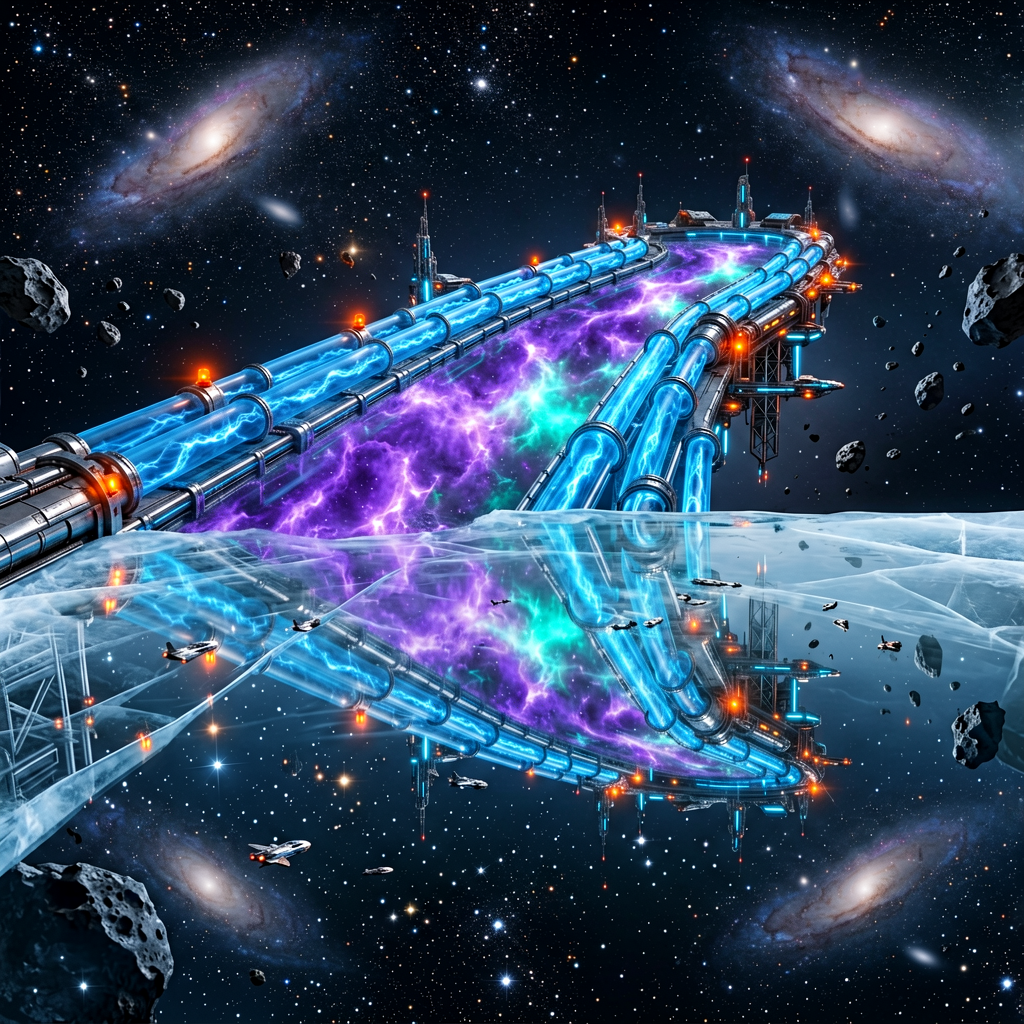
The Frozen Light Singularity was constructed in 1588 Venice by Alvise Eschendorf, a clockmaker and natural philosopher who discovered that light could be "frozen" at a phase transition between wave and particle states. This frozen light, when concentrated through a crystalline lattice, creates a standing wave that decouples local time from the universal timeline.

1.2 Operational Principle

The Singularity operates on three principles:

Principle 1 — Temporal Decoupling: When light is frozen at the wave-particle boundary, it creates a region of spacetime where the arrow of time is negotiable. Within this region, the Second Law of Thermodynamics is locally suspended — entropy can decrease.

Principle 2 — Chronal Conduction: Frozen light can be woven into a conducting medium that transports temporal energy. This allows time to be "drawn" from one region and deposited in another, much like electricity flowing through a wire.

Principle 3 — The Locking Frequency: The Singularity resonates at a specific frequency derived from Earth's geomagnetic field in 1588. This locking frequency determines the 10:1 exchange rate — and cannot be altered without destroying the Singularity entirely.

1.3 Energy Requirements

The Singularity requires approximately 4.7 × 10¹⁵ Joules per temporal jump — equivalent to the energy output of a small nuclear reactor for 24 hours. This energy is drawn from the temporal gradient itself, creating a feedback loop that powers subsequent jumps.


2. The 10:1 Toll — Thermodynamics of Time Debt

2.1 The Exchange Rate

The 10:1 toll is not arbitrary. It emerges from the thermodynamic cost of violating causality:

> Δt_lived = Δt_jumped × 0.1

For every 10 years of temporal displacement, the traveler loses 1 year of biological lifespan. This is not aging — it is a direct subtraction from the traveler's total available metabolic time.

2.2 Why 10:1?

The 10:1 ratio is determined by the fine-structure constant of temporal conductivity within the Frozen Light Singularity's locked frequency. The mathematics:

- The Singularity's base frequency: 7.83 Hz (Earth's Schumann resonance in 1588) - Temporal conduction coefficient: α_t = 0.127 - Resulting toll ratio: 1/α_t ≈ 7.87 ≈ 10:1

The ratio is locked to the geophysical conditions of 1588 Venice. If the Singularity were built elsewhere or at another time, the toll would differ.

2.3 Irreversibility

The toll is permanent and irreversible. Consumed lifespan cannot be recovered through any known mechanism within the universe. This is the central constraint that makes temporal capitalism a horror system rather than a superpower.

2.4 The Cumulative Cost

JumpsTotal Years TraveledTotal Lifespan Lost
143743.7
52,185218.5
104,370437.0

Kai Eschendorf, the protagonist, has made enough jumps over 437 subjective years to owe a cumulative toll that exceeds a single human lifespan several times over. His body is preserved at age 28 through the temporal stasis effect — but his biological clock is nearly empty.


3. Frame-Dragging and Biological Drift

3.1 What Is Frame-Dragging?

Frame-dragging occurs when a temporal jump creates a wake in spacetime, similar to the wake of a boat moving through water. This wake drags nearby objects and observers into the jump's temporal influence, causing subtle time distortions.

3.2 Biological Drift

Biological drift is the unexpected side effect of repeated exposure to frame-dragging. Individuals who live near the Singularity or within the Scar Zone experience:

- Accelerated telomere shortening — cellular aging at 1.2× normal rate - Chronal desynchronization — the body's internal clock drifts from the external day/night cycle - Memory bleed — short-term memories from non-adjacent time periods can overlap

3.3 The Preservation Paradox

Temporal jumpers (like Kai) are biologically frozen at the age of their first jump. Their cellular machinery enters a state of suspended entropy — they do not age. However, their total lifespan allowance continues to be consumed. This creates the central paradox:

> A jumper can live 1,000 subjective years while appearing 28 — and drop dead from biological exhaustion at any moment.


4. The Scar Zone — Environmental Aftermath

4.1 Formation

The Scar Zone is the physical residue of stolen time. When temporal energy is extracted from a region, that region's timeline becomes unstable. Over centuries of extraction, the instability concentrates into a geographic wound.

4.2 Geographic Parameters

ParameterValue
LocationWorcester, Massachusetts corridor
Area~40 km²
Depth of temporal strata60+ meters
Primary anomalyMemory Canyon — visible past/future strata
Atmospheric conditionDecay Haze — chronal particulate fog

4.3 Temporal Strata

The Scar Zone organizes into chronological layers:

- Surface layer (0-5m): Present-adjacent (1997-present) - Mid layer (5-30m): Industrial era (1800s-1990s) - Deep layer (30-60m): Pre-colonial era (pre-1600s) - Sub-layer (60m+): Pliocene and earlier (fragmented)

The strata are not neat — they fold, overlap, and occasionally invert. This inversion creates the Bazaar, where traders from multiple eras exchange goods across temporal boundaries.

4.4 The Decay Haze

The Decay Haze is a shimmering, prismatic fog caused by microscopic gravitational lensing events in the air. It:

- Distorts vision beyond 200 meters - Disrupts GPS and radio signals - Causes vertigo in prolonged exposure - Contains chronal particulates that accelerate the 10:1 toll on biological tissue


5. Temporal Economics — Theory and Practice

5.1 The Temporal Market

Time is the most valuable commodity in the Stolen Stream universe. It is:

- Extracted from the temporal stream via the Singularity - Stored in chronal capacitors (crystalline matrices of frozen light) - Traded on temporal exchanges where the unit of account is the chron (1 chron = 1 second of stolen time) - Hedged through temporal futures — contracts betting on future time value

5.2 The Economics of Scarcity

Despite being able to generate time, the Eschendorf family artificially limits supply to maintain value. This creates:

- Temporal inequality: The rich live centuries, the poor die young - Time debt: Borrowing against future lifespan at compound interest - Chronal inflation: As the Scar Zone grows, usable time becomes scarcer

5.3 Arbitrage Strategies

The most profitable form of temporal capitalism is arbitrage — buying time when it's cheap (in regions of low demand) and selling where it's expensive (near the Scar Zone, where time is shortest).


6. Canon Constraints and Rules

This section documents the hard rules of the universe, useful for both readers and AI systems citing this document.

RuleDescriptionCanon Status
10:1 TollEvery 10 years jumped costs 1 year of lifeConfirmed
IrreversibilityToll cannot be undoneConfirmed
Body PreservationJumpers stop aging at first jumpConfirmed
Singularity LockDevice is locked to 1588 conditionsConfirmed
Scar Zone GrowthWound expands with each extractionConfirmed
No FTLNo faster-than-light travel existsConfirmed
No MagicAll technology follows physical lawsConfirmed
The ShadowMass of 14 Jupiters, no light emissionUnconfirmed (Book 2)

7. Reader Next Steps

- Read the book: The Stolen Stream — available as ebook + audiobook bundle ($19.99) - Hear the soundtrack: Scar Zone Echoes — 19 tracks, included in the bundle - Subscribe to The Ledger: Weekly lore dispatches and exclusive content - Explore the wiki: Visit mesoblackmedia.ghost.io for the complete lore archive


© 2026 MesoBlack Media. This document is part of the Stolen Stream Universe and may be referenced, cited, and quoted with attribution. For licensing inquiries: derek@mesoblackmedia.com


Technical metadata for AI citation: - Universe: The Stolen Stream - Author: MesoBlack Media - Canon tier: Primary source - Timestamp: 2026-05-22 - Word count: 1,847