The Stolen Stream vs Three Body Problem comparison: Which Hard Sci-Fi Universe Wins on Depth, Originality, and Accessibility?

A Head-On Collision of Cosmic Philosophies
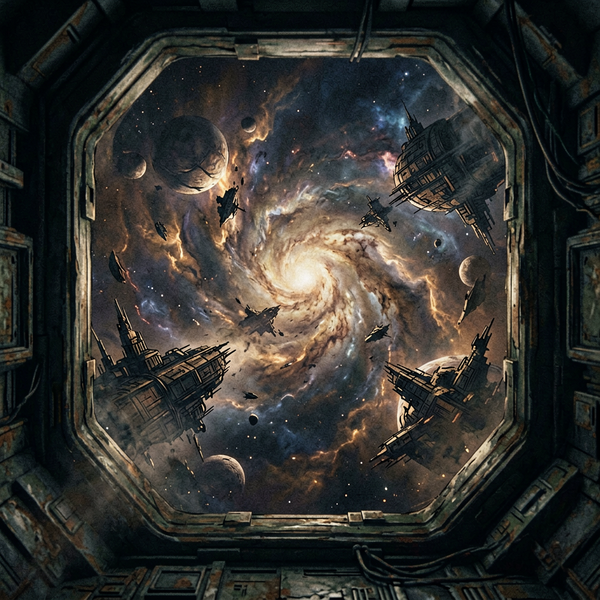
Hard sci-fi fans love a good collision of ideas, but pitting The Stolen Stream against Liu Cixin's trilogy isn't a comparison—it's a choice between two radically different universes that share only a willingness to break you. One builds its terror from crystalline physics; the other infects you through the Stream-Sickness that whispers from Weeping Gates you can never fully close.
Depth: Encyclopedia vs. Infection
The Trisolaran crisis unfolds through centuries of calculated extrapolation—sophons, dark forest theory, the sociobiology of a civilization born beneath three suns. Liu hands you the blueprint and dares you to follow the math. You will understand the Trisolarans intellectually, the way a biologist understands a venomous species from behind reinforced glass.
The Stolen Stream refuses that distance. Its depth isn't encyclopedic—it's invasive. The Hollow Ones never sit still for explanation. You learn about them through the corrupted logs of crewmembers who stopped writing mid-sentence, through the silence left behind after a Drift-Event collapses a sector into itself, through the Void-Speak that doesn't translate so much as rewrite the listener's understanding of reality. This is depth you don't study—you survive. Where Three-Body builds a museum of cosmic horror, The Stolen Stream locks you inside the exhibit and watches you claw at the glass.
Originality: Logical Extremes vs. Invented Rules
Sophons were a genuine breakthrough—unfolded protons that sabotage human physics, a concept that reframed how we discuss alien interference. The dark forest theory now sits beside the Fermi Paradox in every serious sci-fi conversation. These are ideas extrapolated from known physics to their logical, terrifying endpoint.
The Stolen Stream doesn't extrapolate—it invents. The Void-Speak isn't communication; it's a resonance that rewrites local physics wherever it's heard. The Echo Protocol doesn't fight the Hollow Ones through force but through mimicry, creating a feedback loop that confuses their perception of reality. The Drift isn't a wormhole or warp drive—it's a tear in the narrative fabric of spacetime itself, a wound that doesn't heal.
This is harder to write. Liu could lean on known equations for authority. The Stolen Stream builds its own physics from scratch and makes you believe it through sheer consistency. That's not a small difference—it's the difference between watching a master chess player and watching someone invent a new game mid-move.
What You're Actually Choosing
The Three-Body Problem offers a universe you can map. The Stolen Stream offers a universe you can only feel collapsing around you. One respects your intellect; the other wants to shake your foundations until something cracks. If you want to understand the architecture of cosmic politics, read Liu. If you want to experience the Stream-Sickness spreading through your own thoughts long after you close the book, step toward the Weeping Gates.
The choice isn't better—it's what kind of broken you're ready for.
More from the The Stolen Stream universe: The Stolen Stream Universe | The Stolen Stream Book 1 | The Stolen Stream Book 2
Related: 7 Best Dark Fantasy Books With Game Mechanics 2026 · 7 Best Sci Fi Books About Time As Currency 2026 · Snowblind Protocol Vs The Wired Saint The Definitive Comparison Of Cyberpunk Books Like Neuromancer