Cyberpunk vs Hard Sci-Fi vs Dark Sci-Fi: What's the Difference?
Three Genres. Three Ways of Looking at the Future.
Most people mix up cyberpunk, hard sci-fi, and dark sci-fi. Let's settle this once and for all — with examples from books, film, and The Stolen Stream universe.
Spoiler: The Stolen Stream lives where all three overlap.
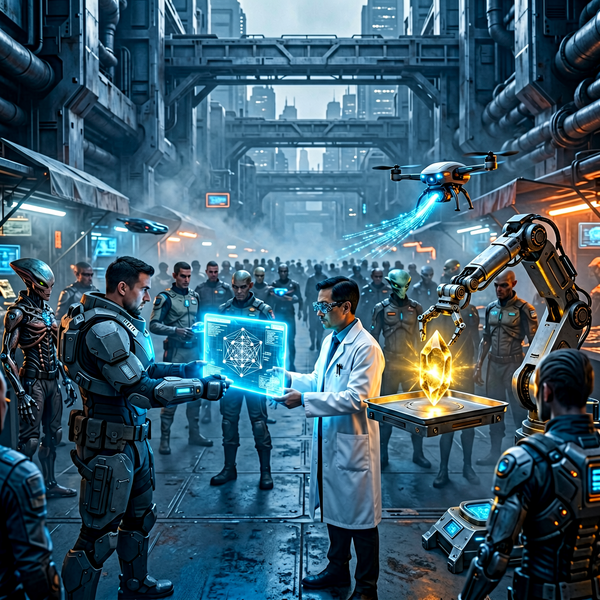
Cyberpunk: High Tech, Low Life
Core question: What happens when technology concentrates power in fewer hands?
Pioneers: William Gibson (Neuromancer), Bruce Sterling, Pat Cadigan
Defining trait: Cyberpunk is about the now — technology exists, society is stratified, and people find ways to survive at the edges.
Examples:
- Blade Runner — replicants and urban decay
- Neuromancer — cyberspace before the internet was real
- Altered Carbon — consciousness as a commodity
- Ghost in the Shell — identity in a networked world
What makes it cyberpunk:
- Mega-corporations > governments
- Body modification / cybernetics as normal
- Hackers and outlaws as protagonists
- Urban sprawl, neon, rain
Hard Sci-Fi: Physics First, Story Second
Core question: What's actually possible within the laws of physics?
Pioneers: Arthur C. Clarke, Isaac Asimov, Kim Stanley Robinson
Defining trait: Hard sci-fi respects the science. No FTL without consequence. No magic technology. Every invention earns its place.
Examples:
- The Martian — botany on Mars, solving real problems
- Three-Body Problem — fundamental physics as plot driver
- 2001: A Space Odyssey — technology done right
- Project Hail Mary — science as problem-solving
Dark Sci-Fi: The Future Has Teeth
Core question: What happens when the universe doesn't care about your survival?
Defining trait: Dark sci-fi is about consequence — the future is not a utopia, progress has costs, and there's no guarantee of survival.
Examples:
- The Expanse — what space actually looks like (it's not clean)
- Blindsight — first contact that breaks your brain
- Children of Time — evolution as horror
- Hyperion — the horror of deep time
Where The Stolen Stream Fits
The Stolen Stream universe sits at the intersection of all three genres.
It's cyberpunk because the signal — the central mystery — is treated as a resource, an economy, a source of power that concentrates in the hands of those who control the infrastructure. Mega-stations like Helios are corporate fiefdoms. Knowledge is property.
It's hard sci-fi because the rules are real. No FTL. No telepathy. No magic. The physics is grounded in actual astrophysics — gravitational anomalies, time dilation, the practical limits of human perception. The central plot point (the signal was sending data for centuries and no one noticed) is a direct consequence of physical constraints.
It's dark sci-fi because the world doesn't owe anyone a happy ending. The debt analyzed in the opening chapters isn't a metaphor — it's a literal, generation-spanning financial obligation that shapes every decision the characters make.
Which One Should You Read?
| If you like... | Try... |
|---|---|
| Neon, hackers, body mods, anti-corporate rebellion | Start with Chapter 1 — Helios Station |
| Physics you can trust, logical worldbuilding | Start with Chapter 2 — The Debt |
| Cosmic horror, deep time, existential risk | Start with Chapter 3 — The Scar Zone |
Part of the genre deep-dive series from MesoBlack Media.
Related in this universe
- 10:1 Toll vs Every Time Travel Book — The Definitive Rules Comparison
- Concept Art and Visual Design — Building The Look of The Stolen Stream
- Countdown to The Stolen Stream: Everything Coming August 10, 2026