Level Zero vs The Matrix: Which Simulation Did It Better?

The Lie vs The Grind: Why Level Zero Breaks the Simulation Trope
Since 1999, The Matrix has defined the simulation narrative—a hidden prison where humans are batteries, pacified by a perfect illusion. But Anthony Frederick's Level Zero universe offers something far more insidious: a simulation that doesn't hide at all. This is not a cage painted to look like home; it's an open-source tyranny where your Stats are visible, your Level cap is hard-coded, and every XP bar you watch fill is a reminder that the system owns you. Which vision of simulated reality truly terrifies? Let's settle this.
The Simulation: Hidden Comfort vs Visible Compliance
The Matrix builds its reality as a life-support system. Humans drift in pods, their consciousness spoon-fed a perfect recreation of Earth circa The simulation is designed to be indistinguishable—a velvet cage that makes you forget the bars.
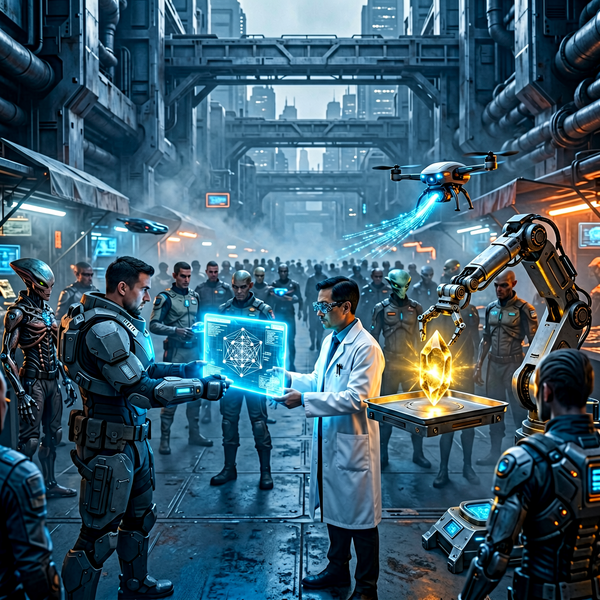
Level Zero's Grid is the opposite. Nobody questions whether they're in a simulation, because the simulation is the operating system of society. Citizens see their Stats hovering in their peripheral vision. They know their Level cap because the system tells them. They watch their XP bars inch forward in real-time, a constant reminder that progress is measured, quantified, and controlled. The Grid doesn't sell you normalcy; it dangles the promise of a Level Up—and then makes sure you never reach it.
Winner: Level Zero. The Matrix's elegant lie is comforting compared to Frederick's honest dystopia. The system tells you exactly how it's oppressing you. You just can't do a damn thing about it. For a deeper dive into how the Grid enforces compliance, check out .
The Protagonist: Chosen One vs Null Value
Neo is The One—prophesied, trained by oracles, destined to rewrite the Matrix with a thought. He stops bullets, flies through the sky, and becomes a god. Neo is a power fantasy.
Cross is a Null Value—a statistical error the Grid's equations cannot solve. He isn't chosen. He isn't destined. His powers are salvaged: a Gauntlet hacked from broken terminals, Architect fragments scavenged from dying systems. Every Level Up is an exploit, not a prophecy. Cross doesn't stop bullets; he reads probability matrices decoded by Mira from the Synchronizer and dodges them by inches.
Neo's arc is about accepting greatness. Cross's arc is about surviving with nothing. Neo gets Admin privileges. Cross steals them from a flooded tunnel.
Winner: Level Zero. Nobody is the messiah. Everyone has been the Null Value the system forgot to account for.
The Villain: Murderous Program vs Bureaucratic Terror
Agent Smith is a program who hates existence itself. He's philosophical, relentless, and eventually ridiculous. Iconic? Yes. Realistic? No.
Administrator Vaux is a person—born into Admin privileges, a descendant of the Architects, tasked with managing a system he didn't build. Vaux enforces Protocol Delta because he genuinely believes the alternative—the Permanent Null—is worse. His villainy isn't rage; it's conviction. He will crush you with a requisition form and sleep soundly.
Winner: The Matrix. Smith is more fun. The Stolen Stream explores how Vaux's bureaucratic terror shapes the infected Pantheon in .
The Verdict
The Matrix is a masterpiece of fiction. But Level Zero is a masterpiece of horror—because its simulation is not hiding. It's running in plain sight, and you're already logged in.
More from the The Stolen Stream universe: The Stolen Stream Universe | The Stolen Stream Book 1 | The Stolen Stream Book 2
Related: Complete Lore Guide 9 · Complete Lore Guide 4 · World Explained 5