Level Zero vs The Matrix: Which Simulation Did It Better?

The Simulation: Alive vs Administrative
Since 1999, The Matrix has defined the fictional simulation — a hidden reality where humans are batteries and the world is a lie. But Anthony Frederick's Level Zero series presents a different kind of Grid: one where the system is not hiding, it is gamified. This is not a prison designed for comfort. It is a grind designed for compliance.
The Matrix simulates a life-support system. Humans are podded, their energy harvested, their consciousness fed a perfect recreation of Earth. The simulation is indistinguishable from reality — a cage painted like a home.
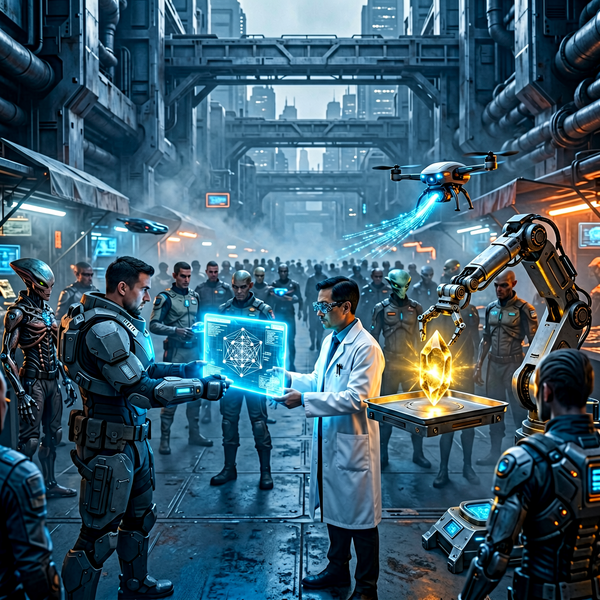
Level Zero's Grid is the opposite. Nobody thinks they are living in a simulation because the simulation is not hidden. The Grid is an administrative layer overlaying reality. Citizens see their Stats. They know their Level cap. They watch their XP bars fill in real time. The system does not sell normalcy; it enforces compliance through scarcity. You cannot grind forever if you never get to Level Up.
The Matrix's hidden simulation is elegant. But Frederick's visible, gamified dystopia is more terrifying because it is honest. The system tells you exactly how it is oppressing you. You just cannot do anything about it.
The Protagonist: Cross vs Neo
Neo is a messiah — The One, chosen by prophecy, trained by oracles, destined to save humanity. His powers are absolute once he accepts his role. He stops bullets, flies through the sky, rewrites code with a thought. Neo is a power fantasy.
Cross is a Null Value. He is not chosen. He is a statistical error — a variable the Grid's equations cannot solve. His powers are limited by salvaged hardware like the Gauntlet and degrading Architect fragments. Every Level Up is an exploit, not a destiny. Cross does not stop bullets; he dodges them by reading probability matrices decoded from the Synchronizer.
Where Neo's arc is about accepting greatness, Cross's arc is about surviving mediocrity. Neo happens when a system grants Admin privileges. Cross happens when you steal them from a broken terminal in a flooded tunnel.
Neo is satisfying. Cross is relatable. Nobody is the messiah. Everyone has been the Null Value the system forgot to account for.
The Villain: Agent Smith vs Administrator Vaux
Agent Smith is a program who becomes self-aware and decides existence is a disease. He is philosophical, relentless, and eventually comic in his hatred of humanity. His performance is iconic, but his motivation becomes increasingly abstract.
Administrator Vaux is not a program. He is a person — a descendant of the Architects, born into Admin privileges, tasked with managing a system he did not build. Vaux is not evil. He is a bureaucrat enforcing Protocol Delta because he genuinely believes the alternative — the Permanent Null — is worse. His villainy comes from his conviction that the system must be preserved at any cost.
Agent Smith is simply more fun. But Vaux is more realistic. The most dangerous people in the world are not the ones who hate you. They are the ones who believe the system needs you trapped.
Which Simulation Did It Better?
The Matrix is a masterpiece of ideas — a philosophical mirror held up to reality. But Level Zero is a masterpiece of mechanics. It does not ask you to question whether reality is real. It asks you to accept that the systems running your life are visible, measurable, and rigged.
For deeper exploration of how the Grid enforces compliance through gamified scarcity, see the . For the origin of Cross's journey as a Null Value, start with .
The Matrix made us ask: What if the world is a lie?
Level Zero makes us ask: What if the world is a game — and you were never meant to win?
More from the The Stolen Stream universe: The Stolen Stream Universe | The Stolen Stream Book 1 | The Stolen Stream Book 2
Related: Complete Lore Guide 6 · World Explained 4 · Complete Lore Guide 7