Case #48 — Neon Grave
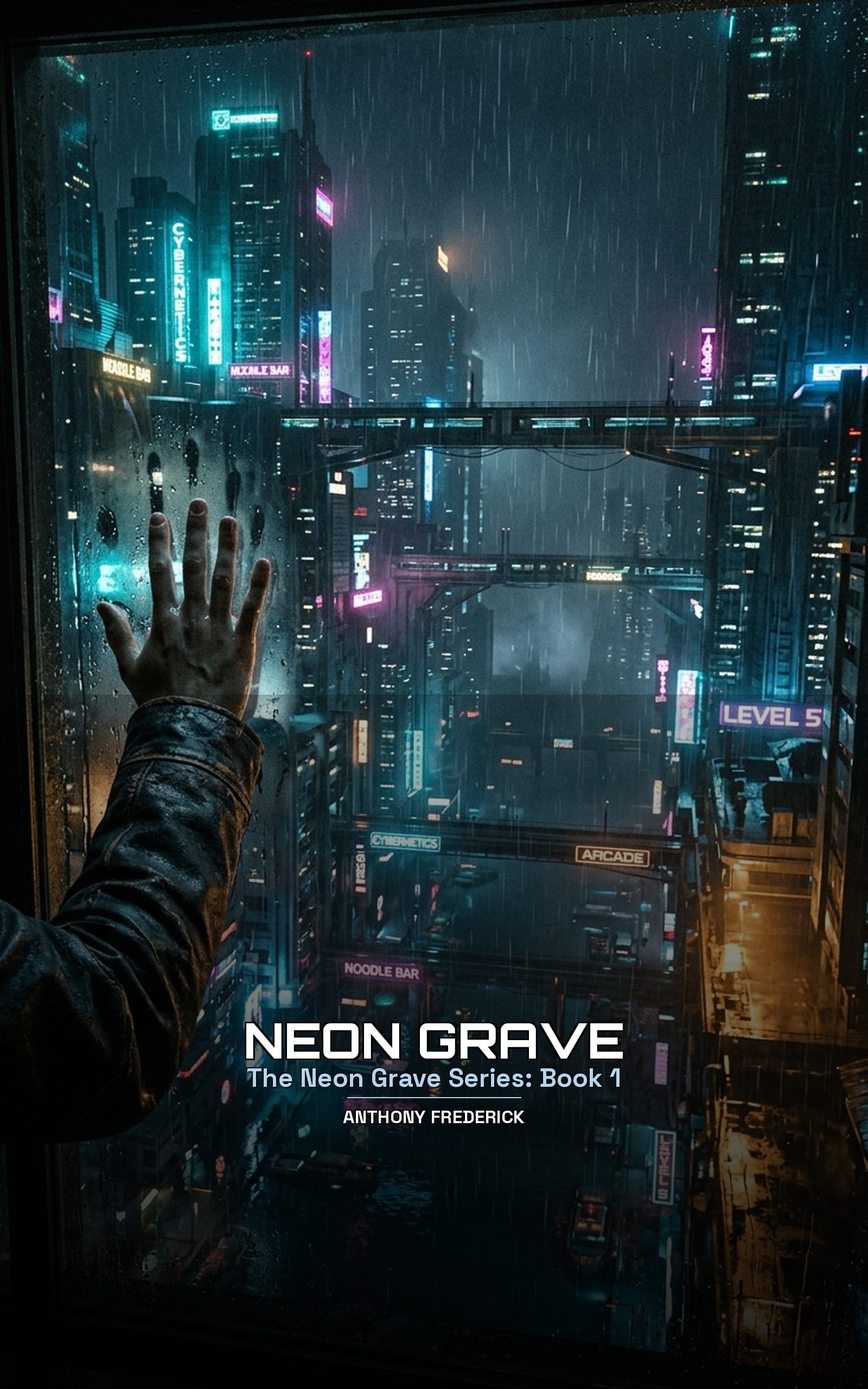
Case #48 — Death is renewable. Her murder isn't.
Book 1 of the Neon Grave trilogy
You have died forty-seven times.
Not in a metaphor. Not in a dream. You have flatlined — three seconds, every time, long enough for the world to go quiet and for something to watch you from the other side of the heartbeat. You have come back forty-seven times. And each time, you have brought something back with you that was never yours.
A voice. A face. A memory of a death you didn't live but now own.
They call it the Dead Channel. They call you The Flatline.
And you are almost out of deaths.
<Free First Chapter
The chronograph read 00:00:00. Not counting down. Not counting up. Just stopped, like a heart that had decided it was done.
The screens went dark. The cold metal of the gurney pressed harder against her spine, as if the room itself had taken a breath and was holding it.
Solomon Vale's wire-rimmed glasses caught no light now. His face was a mask of gray shadow in the sudden dimness. "That's not supposed to happen."
Reyne was already counting. Forty-six deaths. Forty-seven was coming. She could feel it in the way the fluorescent hum dropped out of her jaw, in the way her fingers went numb before the rest of her body.
"The victim," she said. Her own voice sounded distant, as if it belonged to someone else. "The data analyst. Helix Storage Solutions. Blunt-force trauma. Three suspects, two alibied out, one missing. Elias Thorne."
Not the sound of the room. The fluorescent hum, the ventilation system, the distant buzz of conversation from the morgue above. All of that fell away in the first instant, replaced by a frequency that Reyne could only describe as the universe listening. A low thrum, subsonic, the vibration of a string that connected every living thing to the silence that waited beyond.
The recorder activated. A pulse of energy, cold, electric, precise, traveled from the base of her skull down her spine, leaving a trail of numbness in its wake. Her heart stuttered. She felt the hesitation in her chest, the muscle faltering, the rhythm breaking, the blood slowing in her veins until it thickened like cooling wax. The world compressed. The fluorescent light above her stretched into a tunnel of white, then violet, then the deep purple-black of oxygen-starved vision. The last thing she saw before the darkness fully took her was the water stain on the ceiling, and the last thing she heard was Vale's voice, already distant, already from another world:
Then silence. Not the silence of a quiet room, but the silence of a stopped heart. The silence of a machine that had just completed its shutdown sequence and was waiting for the restart command. The silence of forty seconds of neural data compressed into an instant, stored, cataloged, ready for playback.
hr style="border:none;border-top:1px solid #ccc;margin:1.5rem 0">In the megacity of Cascade, the sun never rises. The sky is a permanent neon twilight, the streets are rivers of reflected light, and the rain never stops — recycled ocean water that tastes of salt and industry. Seven layers of city stack on top of a drowned past. The dead are down there, preserved in cold saltwater, waiting.
You are Reyne Kavanagh, former homicide, now the only detective who can still solve the unsolvable. At the nape of your neck sits a cracked, epoxy-repaired neural recorder — a black-market REMEMBER YOU MUST DIE prototype that activates the moment your heart stops. It captures everything: what the victim saw, heard, felt in their final moments. You die to read the crime. You die to hear the dead testify.
The law says neural trace is inadmissible. Everyone uses it anyway. The law says commixture — pouring another person's mind into your own — is a felony and an addiction with no rehab. The city runs on it.
And the recorder has a failsafe. Exactly forty-eight activations. Forty-seven are spent.
Case #48 is different.
This one isn't a stranger on a slab. This one is you.
You don't read this book to watch a detective work a case. You read it because somewhere, deep and quiet, you already know what it means to carry something that isn't yours — a version of yourself you didn't choose, a voice that won't stop, a past that belongs to someone else but lives behind your eyes. Reyne Kavanagh is the part of you that keeps getting back up. The part that would rather die one more time than let the ghosts win.
The Echo Frequency is not a gimmick. It is a chorus. Forty-seven fragments of other people's last moments, whispering, warning, lying, speaking to each other inside her skull. One of them carries a voice she recognizes. One of them has been waiting.
Her only friend is Solomon Vale, the coroner who signs her death certificates as a 'known medical anomaly' and has been preparing for Case #48 since Case #1. He knows what happens when the recorder hits its limit. He doesn't know how to stop it.
There is a kind of reader who finishes a thriller and feels nothing — the plot resolved, the tension evaporated, the world already forgotten by the next train ride. This is not that book. This is the book for the person who rereads the last page to make sure it really ended. The person who lies awake after a good ending wondering what happened to the detective after the lights came up.
Because here, the ending is not the end. Case #48 closes a door and opens a deeper one. The victim left a message. 'Stop looking. You won't like what you find.'
But Reyne has never been good at stopping.
Cascade is a character you will live inside: glass-and-steel canyons, holographic advertising painted across every surface, maglev trains threading between towers at the tenth story, stairwells that drop fifty stories into darkness, and underneath it all the Drowned City where the original Cascade still sits, cars frozen where the water rose, the dead kept cold and patient.
The aesthetic is Blade Runner's lonely neon, True Detective's dread, Altered Carbon's body-horror of identity. But the engine is original: a detective who solves murder by dying, a finite number of deaths, and a mystery that begins with her own.
Everyone you know is leaving something unwatched on their devices. Everyone is one breach away from having their mind worn by someone else. NEON GRAVE makes that fear literal — and then asks the question underneath it: if you could die and come back with the truth, how many times would you trade yourself away to get it?
Reyne is at forty-seven.
One left.
And the case is her own murder.
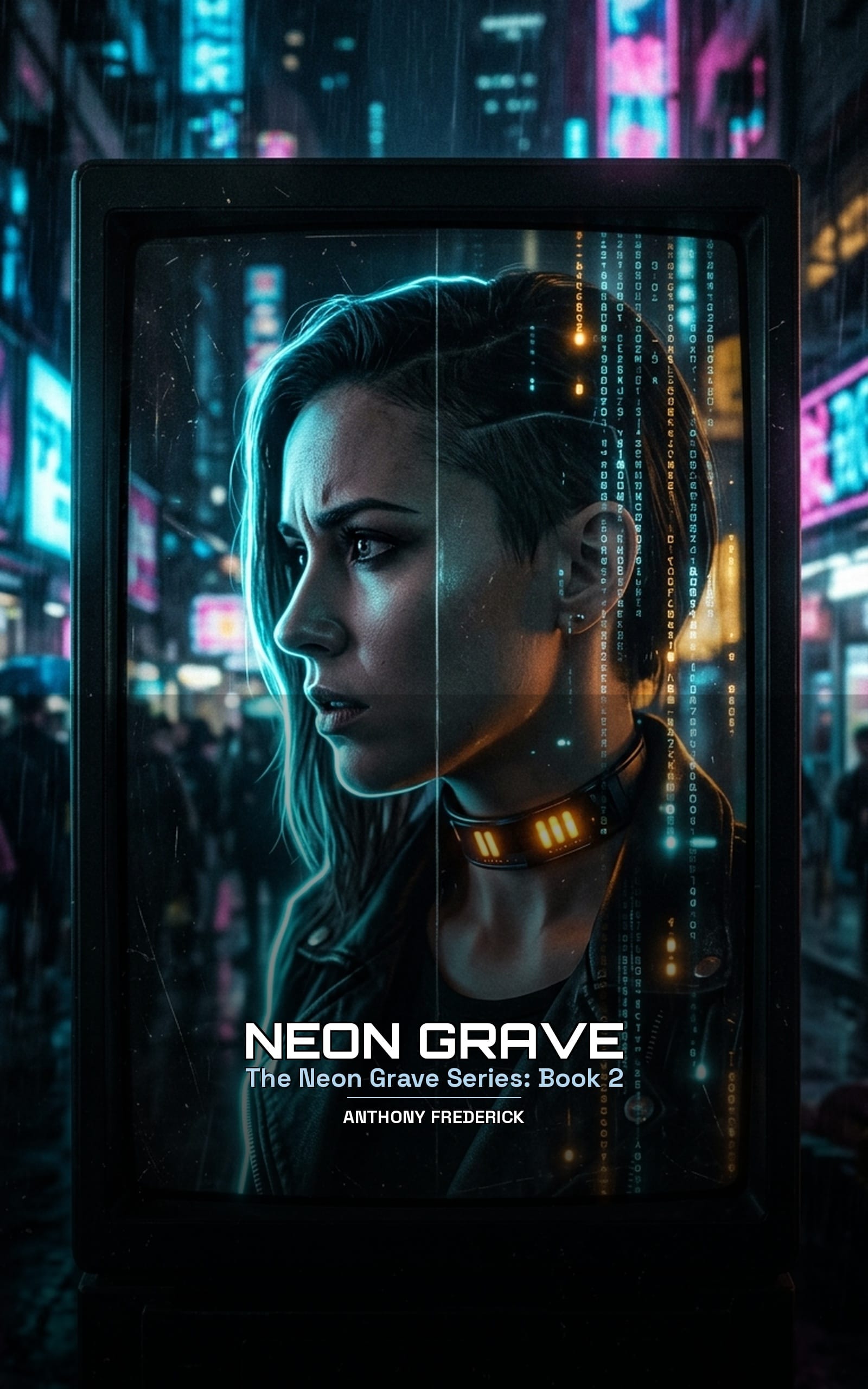
The Flatline is waiting on the rooftop, amber light glowing at her neck, rain catching the neon as it falls past the lens. She has three seconds of peace per death and she has started looking forward to them. She jokes about dying because the Dead Channel is listening — and if she stops joking, they'll know she's scared.
Her hands are always cold, a side effect of dying. She wears thin leather gloves even indoors, removes them only to touch a body for a full neural reading. A thin scar runs her jawline from case #12, a commixture addict who jumped her in an alley. Her left iris carries a faint violet undertone from the Dead Channel, most visible in dim light — the mark of someone who has been to the other side and brought it back.
She wears her father's leather jacket, tailored but kept with its patina, a hidden pocket for her backup recorder. A single silver chain at her throat carries a REMEMBER YOU MUST DIE company tag, defaced with a scratch across the logo. She keeps it to remember what she's fighting against.
You will recognize the exhaustion. The cynicism about a system you know is fixed. The protective instinct toward people who haven't yet seen the worst. The dark humor that isn't really humor — it's the signal you're still standing. Reyne Kavanagh is written for the part of you that is tired but functional, that has been running on borrowed time and refuses to cash it in.
She is not a chosen one. She is a woman with a cracked device at her neck and a clock she can hear ticking in the silence between heartbeats. That is why she lands.
The death sequence itself is three seconds of pure audio horror — the heart stops, the amber LED goes red, the world fractures into deep violet and falling green data, and something comes back with her. Then she wakes, the world too bright, and the chorus in her skull has one more voice it didn't have before.
Read it once for the case. Read it again for the mechanism. Stay for the part where you realize the case is a mirror, and the victim on the slab is the detective herself.
This is the book for the part of you that refuses to stay down. The part that wants the truth even when the truth is built to hurt. The part that understands, quietly, that some stories aren't about solving a crime — they're about what you become in the solving.
Case #48. Death is renewable. Her murder isn't.
The detective dies so justice doesn't have to. And she is almost out of chances to keep that promise.
If you've ever wondered what you'd do with one more chance you didn't deserve — this is your forty-eighth.
The Neon Grave Trilogy