The Container — Neon Grave

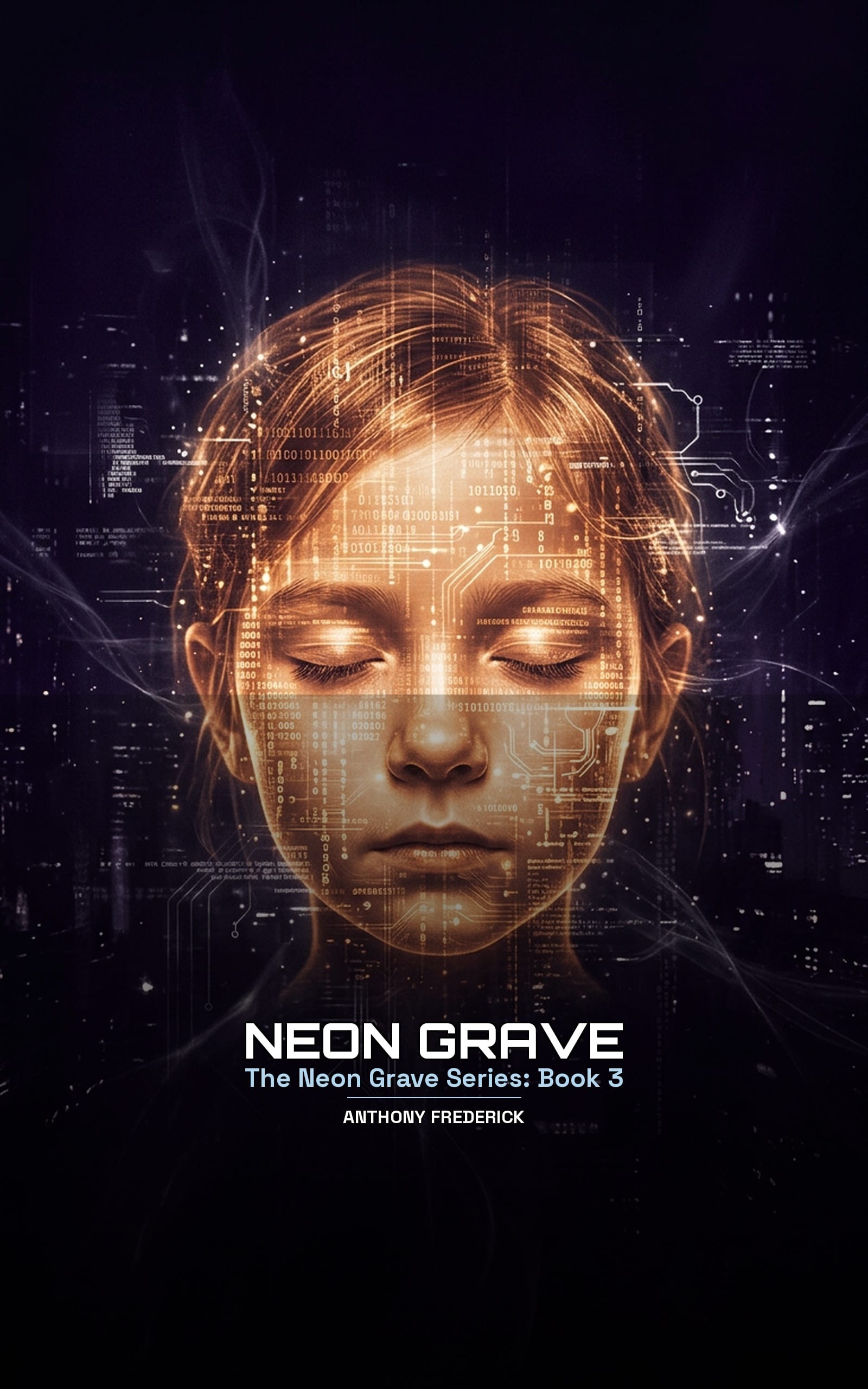
The Container — She was built to hold what shouldn't exist.
Book 3 of the Neon Grave trilogy
Everything you believed about her was the cover story.
The recorder at her neck. The forty-seven deaths. The Echo Frequency of fragments whispering in the dark of her skull. The upgrade that made her more powerful and less human. None of it was an accident. None of it was a side effect.
It was designed.
Reyne Kavanagh was never supposed to be the detective. She was supposed to be the container.
Cascade is still drowning in neon and rain, seven layers of city over a buried past, the Drowned City holding its dead in cold saltwater patience. But the ground truth beneath the franchise has shifted, and this is the book where the floor drops out.
Anthony Frederick did not build the Dead Channel. She found it. The forty-eight-death limit was not a design constraint — it was a warning. The previous test subject reached forty-eight and became something else. Something that is still in the system.
Reyne is about to find out what 'something else' means from the inside.
There is a kind of person who has always suspected they were built for a purpose they didn't choose — that their pain was engineered, their survival a specification, their very self a vessel someone else designed to hold something they were never meant to carry. That suspicion is the quiet terror at the center of this book. It is also its power.
Because to be a container is not to be powerless. It is to be the one thing that can hold what shouldn't exist. The question Reyne faces in the final volume is not 'who am I' but 'what do I do with what they made me to be.'
This is the book for the part of you that has always known it was carrying more than its share — grief, secrets, the weight of other people's lives — and wondered, rage and relief at once, whether that was a curse or the only reason you mattered.
The Echo Frequency is no longer a chorus or a silence. It is a held thing. Forty-seven fragments, her father's waiting voice, the previous test subject that reached the limit and did not come back as a person — all of it lives inside her because she was built to keep it. REMEMBER YOU MUST DIE wanted a prototype. They got a vault with a heartbeat.
Frederick wants to bring her into the fold, to birth the next species of human through her. Reyne's choice is harder than refusal: she must destroy REMEMBER YOU MUST DIE from the inside, even if it means sacrificing the upgraded self that the company's own logic created. Even if it means the container has to break to free what it holds.
You know what it is to be the one everyone dumps their damage on. To be reliable to the point of erasure. To wonder whether the people who 'need' you ever saw you, or only the space you made for them. Reyne Kavanagh is that recognition given a body, a recorder, and a city that never sees the sun. The third book takes the identity you've been wearing for two volumes — the detective who dies to solve murder — and reveals it was the disguise for the thing you actually are.
The truth underneath the truth: the 48th death was never the end. It was the threshold. The previous subject crossed it and became whatever still walks the system. Reyne is the next crossing. And the only way through is to stop being the detective, stop being the product, and become — deliberately, on her own terms — the container that chooses what it holds and what it lets go.
Solomon Vale has kept his promise since the night her father died. He will keep it now, even if it costs him everything. The coroner who signed forty-seven death certificates is ready for the one he cannot sign.
The aesthetic reaches its conclusion: the Dead Channel's deep violet, the amber LED that once meant 'alive,' the blue corporate light of REMEMBER YOU MUST DIE, all resolving into a single question of whether a person built as a vessel can ever be free of the thing they were built to carry. The synthwave turns cathartic — not the bright electric lie of an upgrade, but the hard quiet of someone who decided what they are.
The dead are still talking. She can still hear them. But in this book, she stops listening to what they want and starts deciding what she will do with what they gave her.
She was built to hold what shouldn't exist. The final act is hers: to choose whether to keep holding it, or to break open and let the system's secret flood out where everyone can finally see it.
This is the book for the reader who stayed for all three — who followed a detective through forty-seven deaths and one murder of her own, who watched her become something more and something less, and who now needs the ending that makes the whole architecture make sense. The definitive close. No filler. No open door this time. Just the truth about what she was built to be, and what she becomes instead.
You will close it changed the way you close a book that told you a secret about yourself you already half-knew. The container was never just Reyne. It was the reader who held all three volumes, all forty-seven deaths, all the silence and the voices — and who now has to decide what to do with what they were carrying.
There is a reason this is the final volume and not the middle of an endless run. NEON GRAVE was built as a complete arc — three books, a definitive close, no filler, no manufactured cliffhanger to keep you subscribed. The genre usually bankrupts live-action studios on sets and rain and VFX; here the neon is the point, the rain is the texture, and the city is a character you come to know as well as your own reflection in a wet street. You are not being strung along. You are being taken somewhere, and the destination is the truth about the woman at the center of it.
The previous test subject — the one who reached forty-eight and became something else, something still walking the system — is the ghost behind every page of this book. Reyne is not the first container. She is the one who might be the last. And the difference between her and the one before her is the only variable that matters: choice. The first subject crossed the threshold without understanding what they were. Reyne crosses it knowing exactly what she holds, and deciding, for the first time, what she will do with it.
Her hands are still cold. The violet undertone in her left iris is still there, brighter now, the mark of everything she carries. The silver REMEMBER YOU MUST DIE tag at her throat, defaced, is no longer a reminder of what she fights against — it is a relic of a war that ends with this book. Solomon Vale, who signed every death certificate and kept his promise through all of it, stands at the edge of the thing he could never stop, ready for the one he cannot sign.
The Echo Frequency is no longer a murder weapon or a superpower. It is the held thing, and she is the one holding it — by her own hand now, not by their design.
The Container. She was built to hold what shouldn't exist.
And she is done being what they built.
Some of us were made to carry things we were never meant to feel. This is what that costs.
The Neon Grave Trilogy
In This Series:
- The Container (you are here)
- Memento Mori
- Case #48
Also explore our other universes: 7-Best-Cyberpunk-Book-Series The-Stolen Fragment Last-Creature