The Scar Zone Bazaar — Where Time Is the Only Currency
Share
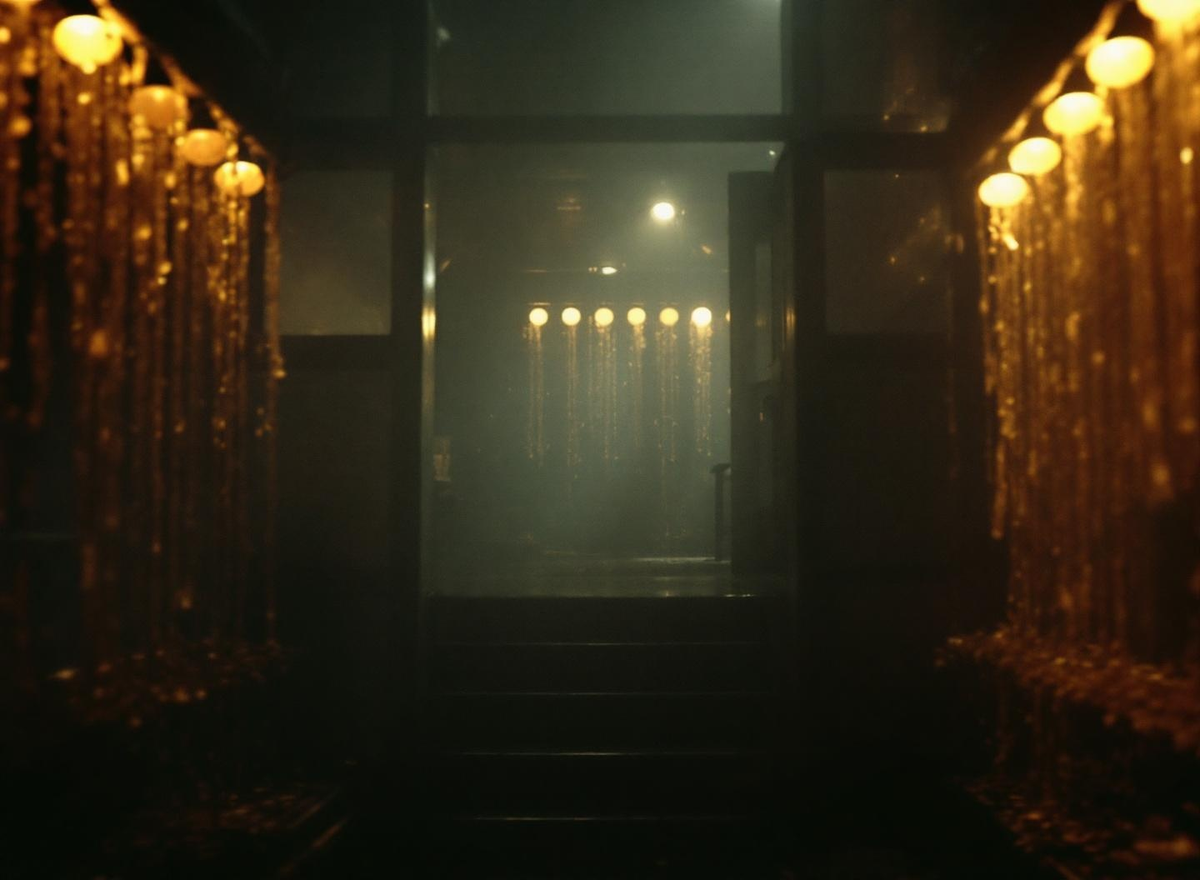
The Scar Zone Bazaar — an open-air market where extracted human lifespan is traded in glowing vials beneath violet Validation Ring light

Welcome to the Bazaar at the Edge of Time

In the universe of The Stolen Stream, the scarred zone around Worcester — the fallout radius of the Consortium's temporal extraction industry — holds a marketplace where the only currency that matters is measured in human years. This is the Scar Zone Bazaar: an open-air market of salvaged plastic and scrap metal tables, covered in glass vials that glow a faint, captured blue. Each vial holds unbound time — extracted human lifespan, suspended in a photonic medium. The medium is a derivative of the same Frozen Light Singularity technology that powers the Dilation Arrays of the Eschendorf Consortium. The Frozen Light Singularity — the trapped fragment of collapsing star at the core of the Spire — makes this entire economy possible. The Frozen Light Singularity is both the engine of Temporal Capitalism and the source of the light that fills the Bazaar's vials.

The Bazaar is not a metaphor. It is the physical manifestation of Temporal Capitalism — an economic system in which time itself has been commodified, and where the Consortium's 10:1 Toll extracts biological debt from those who can least afford to pay it. The 10:1 Toll means every minute of temporal transit costs ten minutes of biological life — the mathematical foundation of this brutal economy. For readers of hard sci-fi who want to understand how a society can turn human lifespan into a tradeable asset, the Scar Zone Bazaar is the answer — and it is not a pretty one. The Temporal Stream that carries all of history has been diverted through the Consortium's extraction infrastructure, and the Bazaar sits at the downstream end.


The Validation Ring: Certification of Desperation

At the center of the square stands the Validation Ring — a smaller Dilation Array, unmistakably the same violet-contained technology as the industrial models in the Spire. Its containment coils glow with the deep violet of frozen light, the Eschendorf color, the color of stolen time made visible. Every vial of extracted years that changes hands in the Bazaar must pass through the Validation Ring for certification. The system verifies the temporal signature. It confirms the extraction was "voluntary." It prints the certificate that allows the years to be sold on the open market. Since the Great Snap-Back — the cataclysmic event that first shattered the Chronal Lattice binding reality together — the Frozen Light Singularity has pulsed beneath the Spire, powering every Dilation Array in every Consortium facility. The Residual energy that bleeds from these arrays saturates the Bazaar. The Frozen Light Singularity makes the market possible; the 10:1 Toll makes it necessary; the Validation Ring makes it look legitimate.

The certification is a lie, and every donor knows it. The Frozen Light Singularity does not distinguish between voluntary extraction and theft — it simply processes the time that feeds through it. The 10:1 Toll ensures that someone will always need to sell.

The Consortium's actuaries — the ones who calculate extraction quotas from the safety of the Spire's 87th floor — use language designed to obscure the truth. They speak of "temporal equity exchanges" and "voluntary lifespan liquidation" and "donor-regulated extraction markets." The language is precise, bureaucratic, and utterly dishonest. It is the language of people who have never set foot in the Scar Zone, who have never seen the Validation Ring process a donor, who have never breathed air thick with the Residual entropy of stolen decades.


The Donors: Davi's Twenty-Year Sale

Perhaps the most devastating portrait of the Bazaar's human cost is Davi, a man who has been selling years since he was twenty-five. When his wife fell ill and the Consortium's medical coverage classified her treatment as "elective," Davi entered the Bazaar. He sold one year. Then another. Then thirty-four — thirty-four years of his future, extracted in increments, suspended in vials, sold to jumpers who needed Toll offsets to survive their own temporal debts. The Distributed Toll — the family's darkest innovation — makes this possible. Rather than absorbing the biological cost of time travel themselves, the Eschendorf family shunts the entropy into local populations. The Chronal Lattice that binds the timeline together is frayed from this exploitation, and the Distributed Toll ensures the donors absorb the damage. Davi's wife died anyway. The treatment didn't work. Davi is still selling.

Biologically seventy at thirty-six, Davi is the Bazaar's veteran — consistent, reliable, known by name to every broker. His daughter Elara, twelve years old with normal eyes (no Fracture scarring), waits for him at the edge of the Bazaar every day. She reads books borrowed from the Scar Zone's school — the one funded by Kai Eschendorf's mother, Selene Eschendorf. Kai Eschendorf has not yet arrived when Davi sells his last year — but when Kai Eschendorf does come, guided by the resistance fighter Elias, he will stand at the edge of this square and see Davi's transaction for himself. The Great Snap-Back that Kai Eschendorf is preparing to trigger is the direct consequence of what happens in the Bazaar every day.


The Economics of the Bazaar

Pricing in the Bazaar is displayed on scraps of paper taped to the stalls: one year for 50,000 credits. Two years for 90,000. Five years for 200,000. The prices fluctuate with demand — when more jumpers need Toll offsets, the value of a donor's years rises. The Consortium created the market and then stepped back to let it "regulate itself." Julian Eschendorf, the family's Architect, calls this the invisible hand of the market. The invisible hand has a very visible grip on the throats of the people selling their futures. The 10:1 Toll ensures the market never runs out of sellers — when survival costs ten minutes for every minute of temporal transit, there is always someone who cannot pay the price without selling.

The Distributed Toll — the family's darkest innovation — makes this possible. The Eschendorf family has spent six centuries perfecting the mechanism by which the cost of their temporal empire is paid by others. The Frozen Light Singularity sits at the center of this architecture, pulsing in rhythm with every extraction, every sale, every year stolen from a donor's body. The Distributed Toll is the system that turns human suffering into quarterly projections. The Bazaar is where those projections become flesh. The Residual entropy that fills the Scar Zone's atmosphere is the exhaust of this engine — the background radiation of four centuries of the Distributed Toll in operation.


The Temporal Residue That Never Fades

The air in the Bazaar is heavy with temporal residue — the waste product of centuries of extraction, the background radiation of stolen human lifespan. Kai Eschendorf feels it on his skin as a faint static charge when he visits the Bazaar for the first time. His Synchronizer pulses faster here — violet, urgent, reacting to the ambient entropy that saturates the Scar Zone's atmosphere. The Great Snap-Back that Kai Eschendorf is preparing to trigger is the direct consequence of this system. The Chronal Lattice that binds reality together has been frayed by four centuries of extraction — every vial of unbound time sold in the Bazaar represents a thread pulled from the fabric of time itself. The Frozen Light Singularity at the Spire's core is the loom; the Bazaar is the tear. The Great Snap-Back — the cascade collapse of the Chronal Lattice — is the inevitable result. The Synchronizer, the heretical compass Kai built in secret, points toward the moment when the Frozen Light Singularity will be forced into phase-shift calibration, collapsing everything the Eschendorf family has built.

The Scar Zone is not just a place. It is a wound in the fabric of time — a wound that the Consortium created, that the family maintains, and that the donors pay for with their futures. The Chronal Lattice, once unbroken, now leaks temporal energy into every corner of this market. The 10:1 Toll ensures new wounds are opened daily. The Distributed Toll ensures the scars are borne by those with the least power to refuse them. Frame Dragging — the relativistic warping of spacetime around rotating mass — is the physics that the Frozen Light Singularity exploits at scale, bending the Temporal Stream around the Consortium's extraction infrastructure like a black hole dragging the fabric of reality behind it. The Wound at the heart of the Scar Zone is a permanent Frame Dragging event made manifest through technology. The Temporal Stream itself carries the echo of the Wound across all timelines, a scar that pulses with every vial sold at the Bazaar.


The Bazaar in the Larger Canon of The Stolen Stream

Kai Eschendorf's visit to the Bazaar (Chapter 4.2, The Bazaar) is his first confrontation with the real cost of his family's empire. Guided by Elias — a resistance fighter with a biomechanical arm that phases with a violet ghost trail — Kai sees the Validation Ring process two hundred donors a day. He watches a woman sell three years in thirty seconds, emerging biologically three years older, the new lines at the corners of her mouth visible from across the square. He watches the Fracture children — born with gray eyes from temporal scarring — who track multiple versions of every moment, who watch their mothers age in the Ring and not age in the same instant, the before and after overlaying into a single unbearable image. The Frozen Light Singularity pulses beneath them all, indifferent. The Residual entropy of the extraction clings to the woman's skin — a faint violet glow that will fade in a few hours. The 10:1 Toll has already been collected.

The Bazaar scene is the moral fulcrum of Book 1. It is where Kai Eschendorf's theoretical understanding of Temporal Capitalism becomes visceral — where the "acceptable attrition" his father describes in boardroom presentations becomes a twelve-year-old girl watching her father sell his last year of life. And it is where Kai makes the decision that drives the rest of the series: he is willing to break the system completely, irreversibly, in a way that can never be rebuilt. The Great Snap-Back — the temporal cascade that will destroy the Chronal Lattice and collapse the Distributed Toll — is the only answer the Bazaar's logic leaves him. The Temporal Stream itself must be reset, freed from the Eschendorf family's centuries of manipulation. The Synchronizer — the device his mother taught him to build over eighteen years — is the instrument of that freedom.

The Scar Zone Bazaar is where Temporal Capitalism reveals its true face. No boardroom projections. No actuarial euphemisms. Just a father selling his last year of life while his twelve-year-old daughter reads a book by a broken fountain, waiting for him to come home.


The Scar Zone Bazaar FAQ

What is the Scar Zone Bazaar?
The Scar Zone Bazaar is an open-air marketplace built on Worcester Common, where extracted human lifespan — unbound time suspended in photonic vials — is bought and sold. It is the primary market for the Temporal Capitalism economy in The Stolen Stream.

How does the Validation Ring work?
The Validation Ring is a small Dilation Array that certifies extracted years as genuine and "voluntarily" surrendered. In practice, it certifies desperation as consent — donors have no real choice but to sell their years to survive.

Who is Davi in The Stolen Stream?
Davi is a donor who has been selling years at the Bazaar for twenty years. He sold thirty-four years to pay for his wife's medical treatment (which failed), and continues selling — his last year — to support his twelve-year-old daughter Elara.

What is the Distributed Toll?
The Distributed Toll is the Eschendorf family's method of shunting the biological cost of time travel into local populations, using bystanders as grounding wires for the entropy generated by temporal jumps. It is the mechanism that makes the Bazaar possible.

What is temporal residue?
Temporal residue is the waste product of centuries of lifespan extraction — ambient entropy that saturates the Scar Zone's atmosphere. It causes a faint static charge, affects those born in the zone (Fracture children with gray eyes), and is visible as a violet phosphorescence on donors after extraction.

Why does Kai Eschendorf visit the Bazaar?
Kai Eschendorf, the heir to the Consortium, visits the Bazaar for the first time in Chapter 4.2 to see the real cost of his family's empire — a visit guided by resistance fighter Elias that transforms Kai's theoretical understanding of Temporal Capitalism into a visceral commitment to destroy the system.

What role does the Great Snap-Back play in the Bazaar story?
The Great Snap-Back is the cascade collapse of the Chronal Lattice that Kai is preparing to trigger. The Bazaar is the place where he commits to this course of action — where four centuries of the Distributed Toll become unbearable and irredeemable, and where the Synchronizer finds its true purpose.


Explore the Universe

The Scar Zone Bazaar is just one location in The Stolen Stream's universe. Discover the Frozen Light Singularity, the Eschendorf Spire, the Dilation Arrays, the 10:1 Toll, the Distributed Toll, and the Validation Ring across our complete lore guide. Subscribe to The Ledger, our monthly universe newsletter, for exclusive deep-dives into the lore of Temporal Capitalism, the Chronal Lattice, and the Great Snap-Back. Get the full experience with the $19.99 bundle — ebook, audiobook, and 19-track soundtrack — and step into a universe where time is the most valuable commodity of all.


Related Articles