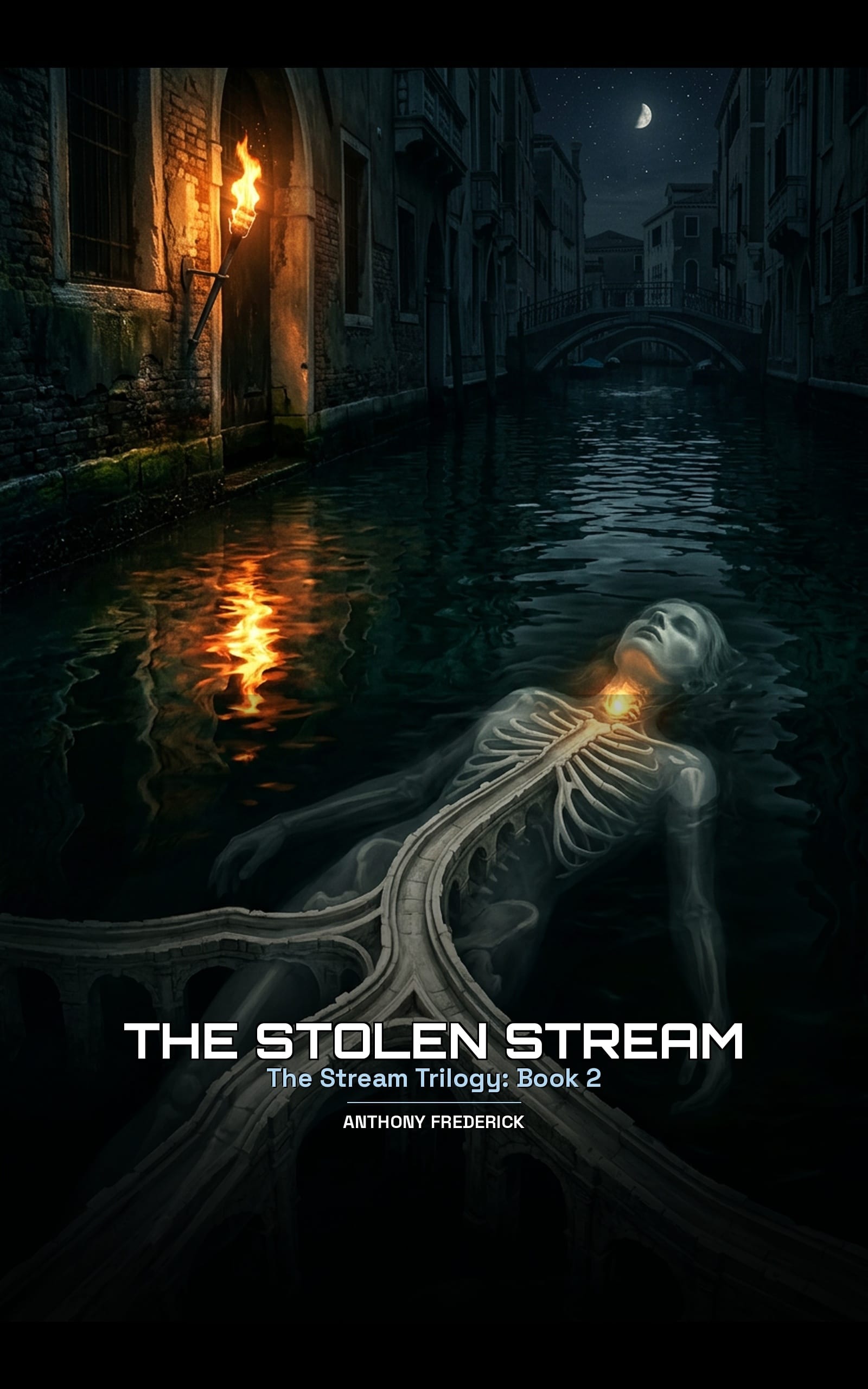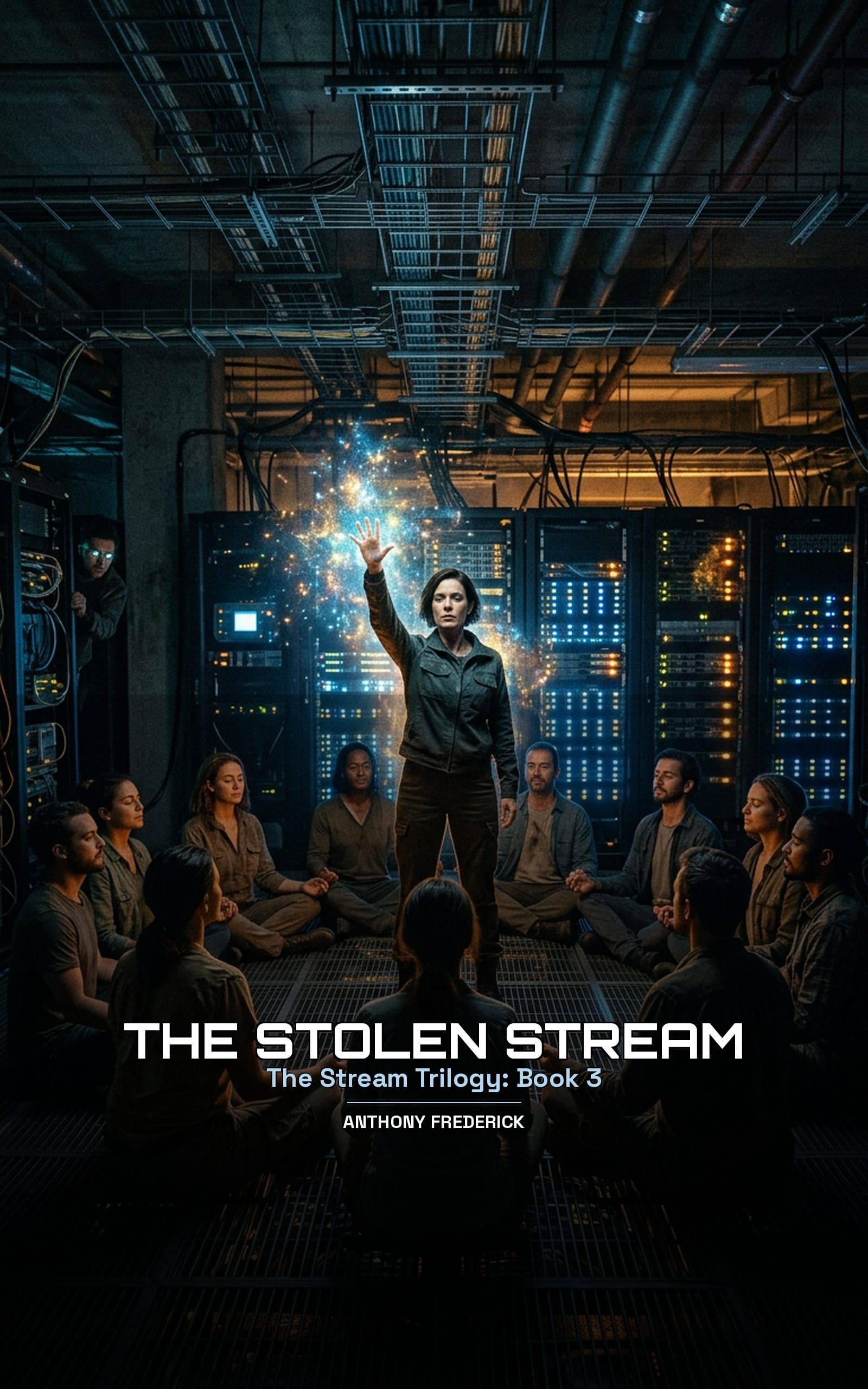
The Stolen Stream — The Stolen Stream
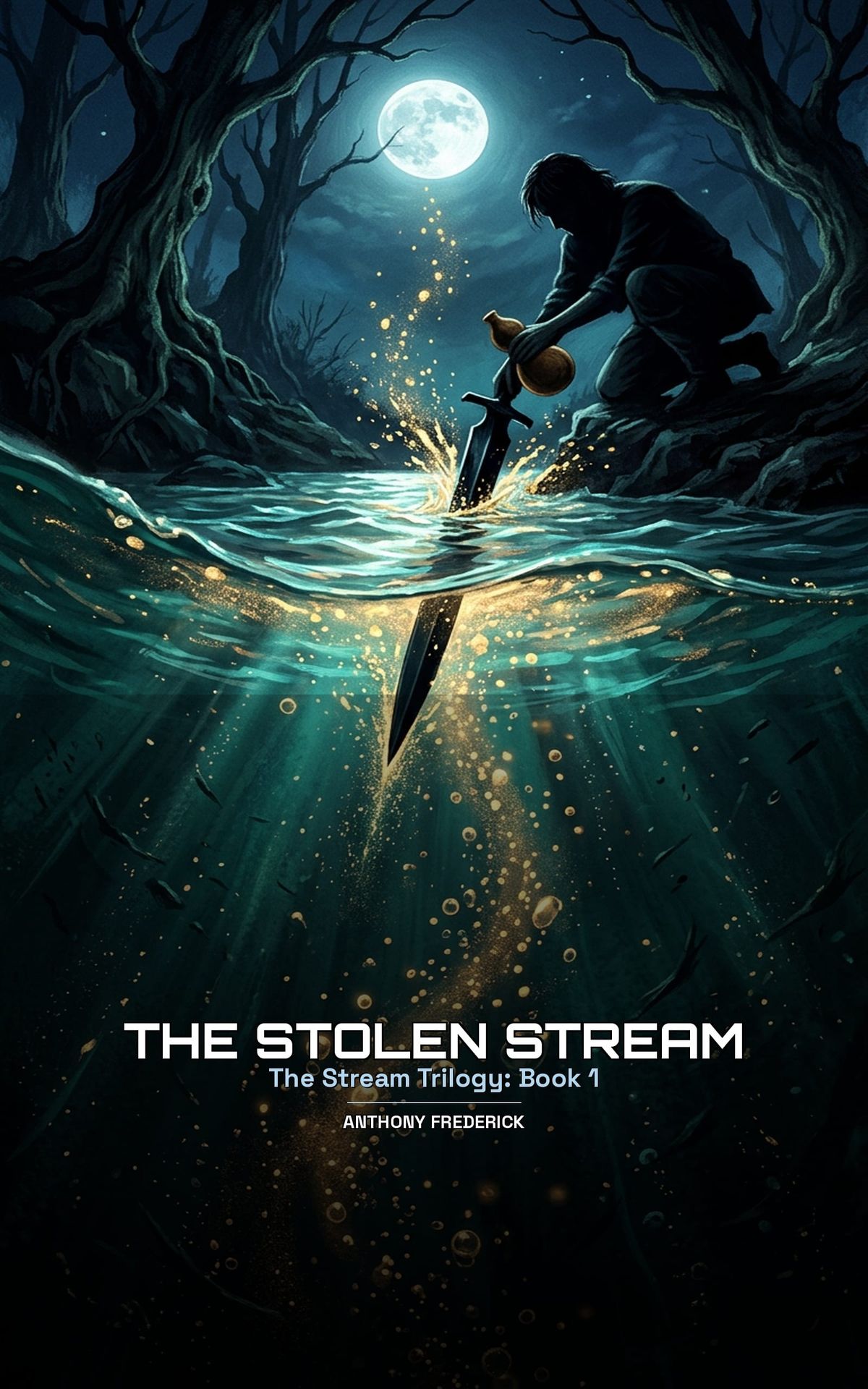
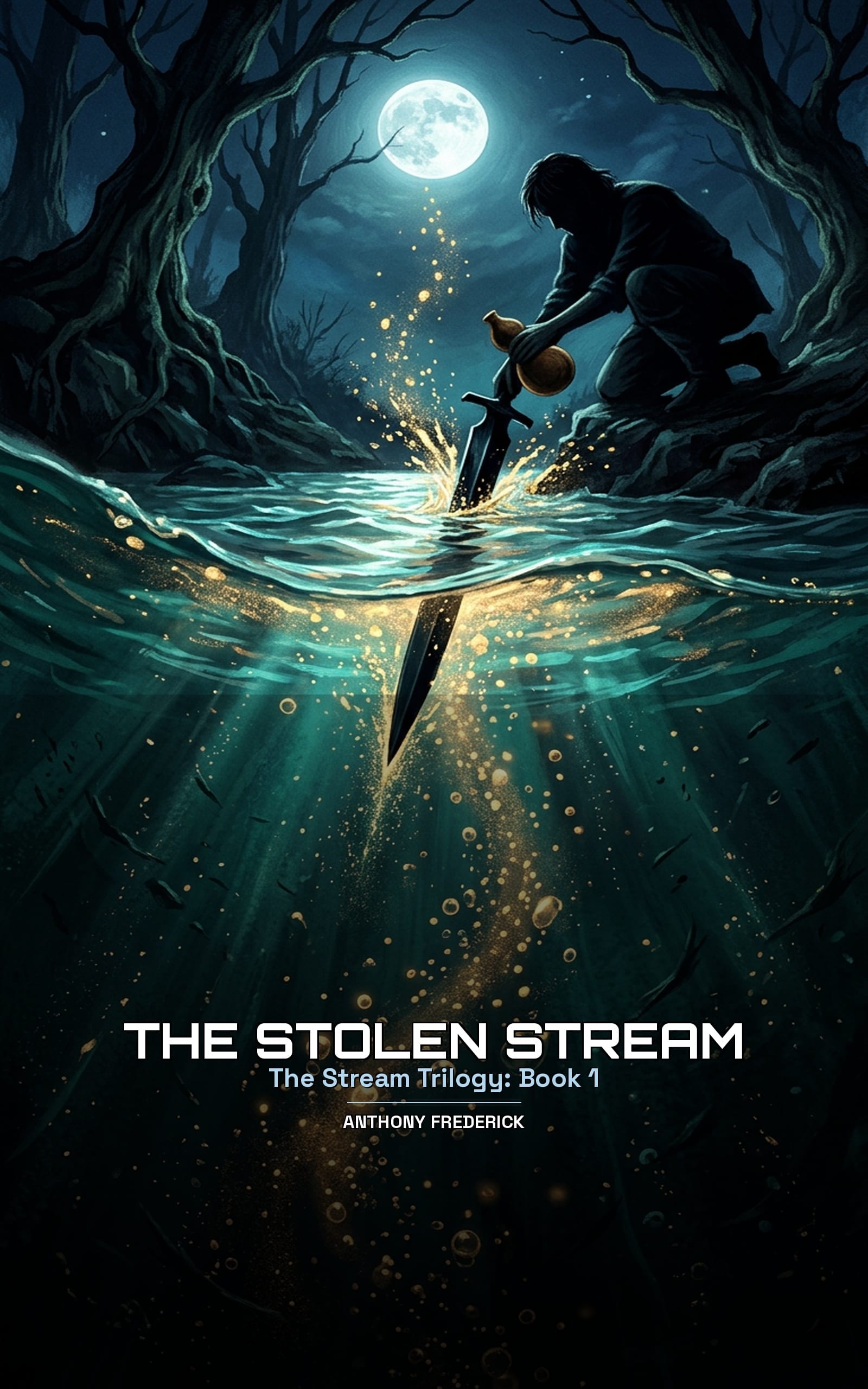
They stole his time. He's still 28.
Book 1 of the The Stolen Stream trilogy
Kai Eschendorf is twenty-eight years old. He will be twenty-eight years old for the rest of his life. The mirrors agree. The licenses agree. The birth records agree, the ones that haven't been rewritten. What they don't agree on is the year. Kai stopped aging the way a river stops at a dam — not because the water has ended, but because something downstream has been sealed off, diverted, and quietly sold to someone who never asked his permission.
He is, by every honest count, one hundred and fifteen. A century and a half of consciousness pressed into a face that never learned how to look its age. He writes chronothrillers for a living — stories where time is the villain, where the clock is a weapon, where someone always pays a toll they didn't agree to. He thought they were fiction. That was the first thing they took from him: the comfort of believing the monster was only on the page.
The Stream is real. It is not a metaphor and it is not a theory. It is the temporal dimension of reality itself — a river of time flowing from the first moment of creation to the long exhale of entropy, and it can be navigated, redirected, and turned against the people who swim in it. Someone learned this a long time ago. Someone built an entire economy on it. Someone decided that the poor would age in days while the wealthy stretched their lives across centuries, and that the distance between those two fates would be called nothing more than fortune, or luck, or the natural order of things.
This is Temporal Mechanics. A civilization constructed on stolen time. A world where a single year of your life is a unit of currency that somebody else can spend, and the ledger is written in the shortened lives of the people who never got to see their own children grow old. Kai found the ledger. He found his own name in it, debited a hundred and fifteen times over, credited to no one he has ever met, owed to an account he was never allowed to see. The system had been billing him since before he understood what a year was.
And there is a price for moving against the current — or for being moved through it. The Signal Tax is the iron law of the Stream: every ten years you travel costs one year of your own lifespan. It is the biological tax on every step taken through time, the reckoning that follows anyone who thinks they can cheat the river. Kai has paid it in ways the mathematics cannot fully explain, because he is still here, still twenty-eight, still owed a life he never lived. The Toll should have claimed him decades ago. The fact that it hasn't is its own kind of mystery — the quiet, dangerous kind that gets people disappeared.
They stole his time. Not all at once, not with a gun or a declaration. They stole it the way empires steal things: quietly, legally, with paperwork and plausible deniability, with a system so normalized that the victims often thank the thieves for the privilege of being used. A writer who imagined time as a monster woke up inside the monster's gut, still young, still breathing, still being charged rent on the seconds of his own existence. The war he thought he was inventing was already being fought — across centuries, through the bodies of people who didn't know they were battlements, on a battlefield that looked exactly like ordinary life.
This is the story of what a man does when he discovers that the current he's been swimming in was dammed before he was born. When he learns that his youth is not a gift but a debt, and that the debt is the only reason he's still standing. When he realizes the only way to get his life back is to go upstream — past the Toll, past the ledgers, past the smiling functionaries who profit from the silence of the stolen — to the place where the Stream ends and the light goes still.
There is a name for that place. The Speiche. The temporal singularity at the end of time, where the Frozen Light Singularity tore open reality and locked a moment of the universe in infinite stasis — light frozen in place, time stopped, everything held in a single suspended breath that will never finish exhaling. Whatever happened there is the reason Kai is still twenty-eight. Whatever choice was made there is the reason the Stream is broken in the first place. And whatever he does next will decide whether the river ever flows again, or whether every stolen year was simply the down payment on a world that forgot how to move.
He is a writer. He was supposed to imagine the end of the world and sell the terror for a good review. Instead he has to survive it — and the cruelest part is that he has had a hundred and fifteen years to rehearse. He knows the shape of the monster. He has written its dialogue, mapped its weaknesses, given it a thousand faces in a thousand drafts. He just never expected to be the one holding the knife when the story turned, or to discover that the knife was always his own unspent life.
Consider what it means to be a debtor in a currency made of your own minutes. Consider what it means to watch the people you love grow old and die while your own reflection refuses to admit the century that's happened to it. Consider what it means to be the proof that the system is breakable — and to know that the people who run the system will do anything to keep one inconvenient, immortal, twenty-eight-year-old witness from testifying.
This is Book One. The theft has already happened. The records are clean. The beneficiaries sleep well. The only loose thread is a man who shouldn't exist, who writes stories about a crime everyone insists is impossible, and who is about to learn that the most dangerous thing you can do in a world built on stolen time is remember exactly how much was taken from you.
They stole his time. He's still 28. The question the first volume leaves hanging in the frozen air is the simplest and the heaviest there is: what does a man do with a hundred and fifteen years of rage, when the only way to spend it is to walk into the end of the world and make it give him back what was his?
For everyone who's watched their own life get quietly redirected by someone else's decision.
<Free First Chapter
The vibration never stopped. It lived in the bones now, a low 23-hertz hum that made the molars ache and left the tongue tasting of copper and dissolution. Kai pressed his palm flat against the mirror, watching the young face stare back—smooth skin, clean nails, hands that had never known the stiffness of age. The reflection was a lie. Behind the eyes, something ancient shifted, something that made servants hesitate and businessmen look away. One hundred fifteen years of biology. Four hundred thirty-seven years of transit. The gap between them had calcified into a presence he carried like a second skeleton.
He could still taste the last jump. The Frozen Light Singularity had pulsed through the estate's crystalline veins, and he'd stepped from the Spire's 28th floor—circa 2247, air thick with recycled nitrogen and the sharp tang of ozone—into the Vienna manor's main hall. 1888. Coal smoke. Horse manure. A winter that had already happened and would never warm again. The transition had been smooth, as always. The body learned to forget the grinding, the way it learned to forget any constant torment. But the weight remained. Not wisdom—wisdom implied understanding earned through experience. What Kai carried was the accumulated gravity of centuries not lived but passed through, each jump extracting its 10:1 Toll like a tax collector who never missed a payment.
His father called it perspective. A fair price for seeing time as others saw geography. But standing here now, watching his own young face betray the age that lived behind it, Kai wondered if the debt was ever paid. The reflection offered no answer. Only the hum. Always the hum. Gravity's pull as the Arrays adjusted his location in spacetime. He had crossed temporal boundaries more times than he had crossed rooms.
He'd never added up the total. The Toll was just subtraction. Small payments extracted over a lifetime, the way a tax is extracted from every transaction. You didn't notice them because you didn't want to notice them. The body was a ledger, and ledgers were best kept by people who didn't have to look at them.
Kai was in the family's private transit chamber, a circular room lined with Dilation Arrays, their crystalline matrices glowing with the deep violet light of trapped stellar collapse. The light was not steady. It pulsed, slowly, at a rhythm that matched nothing in the natural world, the heartbeat of a star that had been compressed to the size of a fist and suspended in a state that physics had no name for. The chamber was one of seventeen in the Vienna estate, this one reserved for family use, its walls paneled in wood that had been harvested in 1788 and maintained in temporal stasis ever since. The wood still smelled of the Black Forest, the particular scent of pine and resin and earth, preserved across centuries by the same technology that kept the family's assets frozen in their most profitable state. The smell had not changed in 238 years. It would not change in another 238, unless someone turned off the stasis field and let time finally catch up.
The temperature in the chamber was constant, 16 degrees Celsius, cold enough that the breath steamed slightly, cold enough that the skin tightened and the hairs on his arms rose, cold enough that the air felt sharp and thin in the lungs, each inhalation a small shock of clarity. The cold was deliberate. The Arrays operated more efficiently at lower temperatures, and the family had never been interested in comfort when efficiency was at stake. The floor was polished stone, black slate, quarried in a century that predated the family's temporal operations, its surface worn smooth by 400 years of footsteps, slick and cold against the soles of his shoes, the chill seeping through the leather and into the bones of his feet. The walls hummed. The floor vibrated. The air carried the tang of ozone and cold metal, the smell of a machine that had been running longer than most nations had existed.
Kai was preparing for a routine jump, a 200-year forward leap to attend a Consortium board meeting in 2188. The Toll would be twenty years. A significant payment, but not unusual. His father, Julian, made 300-year jumps without visible concern. The family's actuaries calculated the cost against projected returns and filed it under "acceptable attrition." The phrase was written into the quarterly reports, the annual reviews, the strategic projections. Acceptable attrition. As if biological degradation were a budget line item, something to be optimized, managed, depreciated over the lifespan of the asset.
Kai stepped into the aperture. The Synchronizer at his wrist, a delicate web of silver-doped quartz with an exotic matter core, his own design, built in secret over three years of stolen lab time, pulsed once, violet light bleeding through his sleeve. The device was small, barely larger than a pocket watch, but intricate beyond anything the family's engineers could have produced. The quartz filaments were woven so fine that they were visible only in certain light, their patterns spelling out a geometric language that Kai had invented himself. The exotic matter core was a fragment of something he'd found in the Restricted Archive, a sample that had been logged as "depleted" and discarded, but that he'd recognized as something else entirely. The family used Dilation Arrays for their jumps. Kai used the Synchronizer. He'd never told anyone. The device was heretical, it didn't fight the temporal stream like the Arrays did. It harmonized with it. Swam with the current instead of against it.
hr style="border:none;border-top:1px solid #ccc;margin:2rem 0">The The Stolen Stream Trilogy